Morning digest: October 30, 2026
Binance lost about $6.3 billion overnight in the largest crypto theft on record, and Bitcoin slid toward $78,000. Polymarket and Summer Finance were drained too. Health leads with a lower-fatigue way to squat, jump squats for in-season athletes and a time-efficient sprint block. Q3 growth came in hot at 3.4%, but so did inflation. Manassas has an interim mayor. And Manassas Park police have a sheep in custody.
Blockchain: Binance’s record hack, more drains, tokenized funds keep coming
Binance loses about $6.3 billion in the biggest crypto theft ever. Starting around 4 p.m. ET Thursday, an attacker drained Binance hot wallets across 11 chains. Binance says it began with a compromised DevOps engineer’s laptop that reached a service able to submit withdrawals; no private keys leaked. On Ethereum the attacker abused EIP-7702, the 2025 feature that lets a regular wallet delegate to a smart contract: pre-signed delegations pointed a hot wallet at a “sweeper” contract that emptied it and kept sweeping new deposits for hours. Elliptic puts the total at $6.43 billion, including 18,270 BTC, about $3.8 billion on Ethereum and 233 million XRP, and has verified $2.84 billion frozen, almost all of it USDT and USDC frozen by Tether and Circle within minutes. Ripple, Paxos, First Digital and Arbitrum’s Security Council also froze or secured funds. Binance has suspended withdrawals and says its SAFU emergency fund plus company money will cover all losses. TRM Labs attributes it with high confidence to North Korea’s TraderTraitor (Lazarus) group, and Elliptic agrees that’s likely; that’s investigators’ assessment, not an official finding. At more than 4x the Bybit theft, it’s another reminder that the weak point is the people and signing systems around wallets, not the cryptography, and that issuer freezes now matter, but only for freezable tokens like stablecoins (Binance; Elliptic; AP; Reuters via MarketScreener).
Bitcoin near $78K. Bitcoin was already under $80,000 after the Fed’s hawkish hold and weak tech earnings; the Binance news knocked it down more than 4% more, to about $78,000, with over $600 million of liquidations in an hour. Circle shares fell about 5% after hours (CNBC; CoinDesk).
Polymarket drained through a hijacked third-party script. DebugBear, a performance-monitoring script embedded on polymarket.com, was compromised. Inside the page it could make users’ email-login (Magic) wallets sign without a prompt, dumping their positions into the order book; no smart contract failed. On-chain tracing puts losses at roughly $2.5–2.65 million, which is not a Polymarket figure. Polymarket briefly paused trading, removed the script, referred it to law enforcement and says it will make affected users whole. It’s the platform’s second front-end drain in four months (AP; The Block; BleepingComputer).
Summer Finance hit for about $6 million. A flash loan (an uncollateralized loan inside one transaction) was used to distort Curve DAI/USDC pool and Morpho liquidity and drain the protocol. Early analysis blames how the vaults account for actions within a single transaction, not stolen keys (InvestInCryptoNews).
Base sets Nov. 5 for 200-millisecond blocks. Coinbase’s layer 2 plans to go from one block every 2 seconds to five per second with its Denim upgrade. Block numbers will advance 10x faster, so contracts that measure time in blocks, such as timelocks, need checking. Mainnet node releases aren’t out yet, so the date is a target (Exchange.news).
Briefly:
- Ethena weighs a cash-like fund that isn’t T-bills. A Blockworks Advisory proposal would add Spiko’s Amundi-managed SAFO “Smart Cash” fund, up to $500 million through 2026, to the backing of the USDe synthetic dollar. The fund earns an overnight rate through total-return swaps on a basket that was 99.9% large-cap U.S. stocks in a September snapshot (TokenPost).
- LayerZero picks up a Canadian-dollar stablecoin. Loon chose LayerZero’s standard for cross-chain transfers of its CADC; LayerZero says technical integration hasn’t begun (LayerZero).
- Polygon’s payments stack adds Solana. The Open Money Stack, which bundles bank and card pay-ins, wallets, routing and fiat payouts, now supports Solana alongside Polygon and Tron (Polygon).
- Curve goes live on Stellar, its first native deployment off an Ethereum-compatible chain; StableSwap is live and FXSwap follows an audit (Curve).
- Fundserv tests tokenized fund trading. The network Canada’s dealers use to place fund orders has a first blockchain version running alongside its current system (Fundserv).
- eCash forks off Bitcoin, messily. The drivechain-focused fork split at block 973,728 Thursday afternoon, giving 1 ECX per self-custodied BTC. Its first sidechain proposals were vetoed until one large miner stopped voting no, blocks are coming every ~2 seconds, and Bitcoin transactions are being replayed onto it, so self-custody holders should split coins before spending (eCash).
Health: squat smarter, sprint efficiently, skip the ketones
Trained lifters: Smith-machine squats left less fatigue than free-weight squats. In a randomized crossover study, 19 strength-trained men (about five years of training) did 4 sets of 9 at 70% of their one-rep max, once with free weights and once on a Smith machine. Bar-speed loss and perceived effort were the same, but free-weight squats caused more peripheral and central neuromuscular fatigue afterward. How to use it: since the two tend to build similar strength and size in other studies, the Smith machine is the lower-fatigue pick when you need to recover fast for the next session. Limits: one session measuring acute fatigue, not a training study; small, men only (IJSPP).
Trained athletes in season: light jump squats beat light half squats. In an RCT of 25 highly trained youth rugby players, six weeks of jump squats at 30–40% of max, three times a week alongside games and practice, raised strength by about 7% versus 4% and jump performance by about 16% versus 8% for traditional half squats at the same load. Sprint speed fell in both groups. How to use it: in a busy season, jumping with a light bar keeps building power at low fatigue, but keep dedicated sprint work. Limits: small, young men, six weeks (IJSPP).
Trained athletes: two short sprint sessions a week built repeat-effort fitness. In an assessor-blinded RCT, 24 female college basketball players added either two weekly sessions of 2–3 sets of 6–10 30-meter shuttle sprints (about four times as much rest as work) or continuous running of the same duration for six weeks. The sprint group improved more on the Yo-Yo intermittent recovery test (effect size d = 1.20) and on Wingate peak and mean power. Limits: small; the authors didn’t measure internal training load (Frontiers in Physiology).
Active adults: ketone supplements didn’t speed recovery. A systematic review of 16 trials, 7 pooled, found exogenous ketones had no significant effect on muscle soreness, glycogen refill or creatine kinase, a muscle-damage marker; post-exercise lactate was slightly higher. Spend the money on carbs, protein and sleep. Limits: few pooled studies, mostly active men (Journal of Sports Sciences).
General population: 16:8 and 5:2 fasting both worked; watch the muscle. In a four-week open-label RCT of 68 women with overweight or obesity, a daily 8-hour eating window and two fasting-mimicking days a week together cut 2.7 kg of weight on average, 1.7 kg of it fat and 0.6 kg muscle. The 5:2 group lost more weight and fat over time; muscle loss was similar. About a fifth of the loss was muscle, so pair either plan with lifting and enough protein. Limits: four weeks, women only (Obesity).
Night owls: later class starts protected sleep and exam scores. Among medical freshmen with large weekday-weekend sleep shifts, 71 were randomized to classes at 10 a.m. or later or the usual 8 a.m. start. Late chronotypes on the early schedule scored lower on exams than early types; late types on the late schedule scored about the same as early types and slept longer, with steadier daily rhythms. If you’re a night owl, put your hardest thinking later in the morning. Limits: students only, some comparisons not randomized (Chronobiology International).
General population: “exercise snacks” linked to less muscle loss. In 2,969 U.S. adults with NHANES accelerometer data, each extra daily minute of brief moderate-to-vigorous bouts went with 9% lower odds of sarcopenia (age-related muscle loss) and stronger grip, leveling off around 80 minutes a day. Stairs and brisk walks between tasks count. Limits: cross-sectional, so a link, not proof (Biology of Sport).
Healthy older adults: aspirin didn’t slow functional aging. A secondary analysis of the ASPREE trial, which randomized 18,581 healthy adults aged 65 to 98 to 100 mg of aspirin or placebo daily for about five years, found no benefit on a combined score of cognition, walking speed, grip strength and well-being. Don’t take aspirin for longevity, but don’t stop a prescribed dose without your doctor (GeroScience).
General and local
Growth hot, inflation hotter. The economy grew at a 3.4% annual rate in the third quarter, above the 3.1% forecast and up from 2.2%, led by investment and government spending. September PCE prices rose 0.5% for the month, the most since March, for 3.6% over the year; core PCE was 3.1%, in line with forecasts. That keeps pressure on a Fed that just held with two votes for a hike (BEA; CNBC).
Alphabet’s slide deepens; Amazon next. Alphabet closed down 12.6% and the Nasdaq fell 1.37%, while the S&P 500 slipped 0.30% to 7,720.39. Amazon’s revenue and earnings came in just under estimates, though AWS grew 39%, its fastest in nearly five years; shares fell about 6.5% after hours (Reuters via StreetInsider; AP).
Manassas picks an interim mayor. City Council chose council member Ralph J. Smith on Oct. 26; he serves until a special election on Nov. 2, 2027. Council also accepted a federal grant for 15 more firefighters, enough for four-person engine and ladder crews, while the Center Street garage-and-apartments rezoning failed and is expected back. The airport terminal developer now expects passenger flights to start in November 2027 (Manassas Daily).
Fairfax: free alerts against deed fraud. The Circuit Court clerk now emails property owners whenever a document is recorded on their property, a cheap guard against title fraud; sign up through the My Fairfax portal, open to county and Fairfax City owners (FFXnow).
Aerospace firm picks Reston. Colorado-based Auria will put its East Coast headquarters at 2000 Edmund Halley Dr., investing $1.8 million and creating 78 jobs, with opening expected by mid-2027 (FFXnow).
Lighter note: a sheep in custody. Manassas Park police detained a runaway sheep Wednesday after “a brief food pursuit that led straight into someone’s backyard” near Nancy Street in Blooms Crossing. The suspect “has declined to comment and has been less than cooperative, but appears to be in good spirits.” No charges have been filed, though police “suspect a few outstanding baaa-violations.” The owner can call 703-361-1136 (WJLA; InsideNoVa).
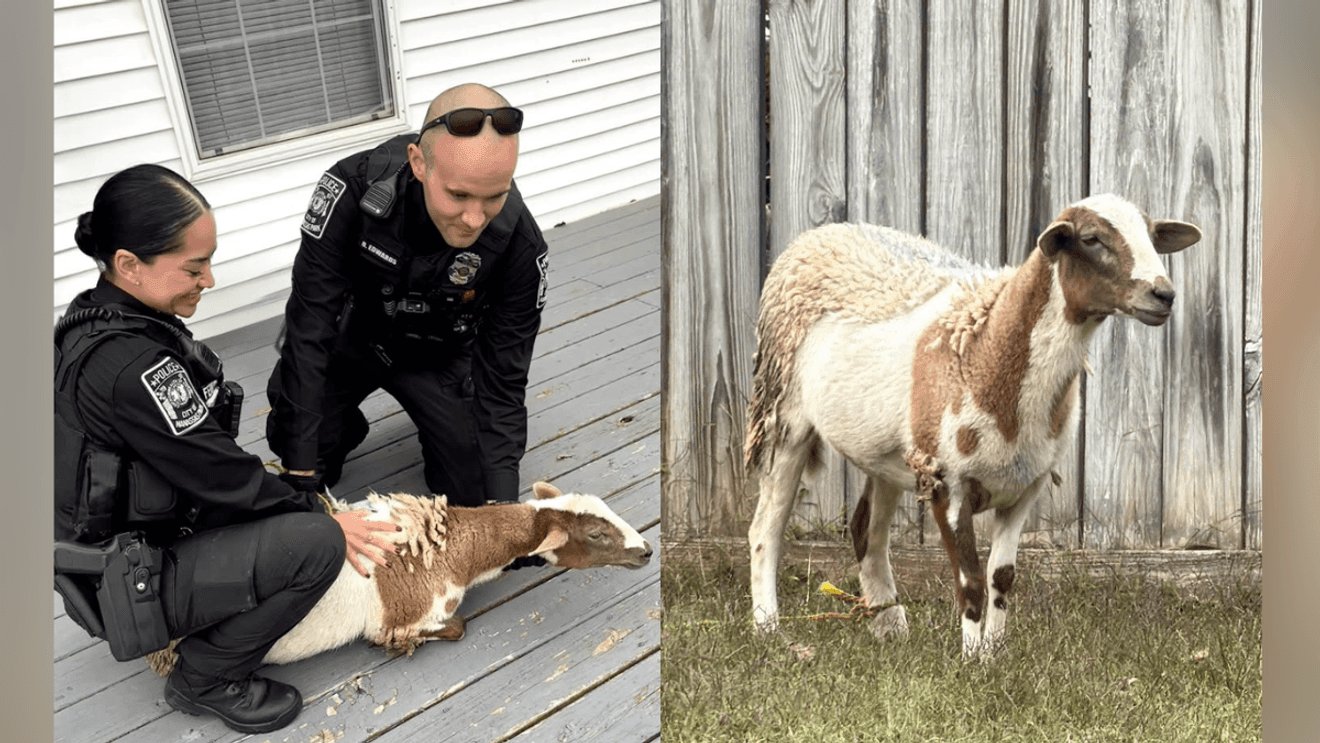
Photo: Manassas Park police, via WJLA.
Russia: Moscow and Voronezh
Moscow and Voronezh. Mayor Sobyanin says 862 drones headed for the Moscow region overnight, even more than the night before; 170 were shot down near the city, and no casualties have been reported. All four Moscow airports were restricted from about 10 p.m. Moscow time Thursday and reopened by 08:57 Moscow time, after about 149 cancellations at Sheremetyevo, so check any flight today. Voronezh downed 10 drones with no injuries or damage reported (RIA; News.ru; MK Voronezh).
Bottom line
Binance’s $6.3 billion hack is the story of the year in crypto, and the quick stablecoin freezes are the one bright spot. In Health, use the Smith machine when recovery matters, keep sprints in the plan, and skip the ketones. Growth is strong but inflation is running hotter, Big Tech is wobbling, and Moscow had another huge drone night with no casualties reported. Manassas has a new mayor, Manassas Park has a sheep, and the sheep is in good spirits.