Morning digest: October 31, 2026
Happy Halloween. Binance says its $6.3 billion breach went wider than one laptop and is aiming to restart withdrawals around Sunday, while Aave froze lending on 16 networks to keep the stolen money out. Bitcoin is near $76,000–77,000. Health leads with trained people: beetroot for soreness and creatine for coming back from an injury, plus exercise for older women’s cognition and good news for weekend warriors. Stocks slid again Friday, Gainesville residents want a data center pause, and Florida had a Grim Reaper ringing doorbells.
Blockchain: Binance’s wider breach, Aave’s circuit breaker, a new bank bid
Binance finds more breach points and targets a Sunday restart. Thursday’s roughly $6.3 billion drain of Binance’s hot wallets (the online wallets that fund withdrawals) is the largest crypto theft on record. On Friday co-CEO Richard Teng said investigators had found more points of compromise beyond the DevOps engineer’s laptop first blamed, and that more than one person was involved. The attacker used EIP-7702, which lets an ordinary wallet hand its logic to a smart contract, to take control of a hot wallet without Binance’s normal approvals, then used a self-destruct mechanism to wipe its tools. Binance says about $3 billion is frozen on-chain and has set aside $6.34 billion from SAFU, its emergency fund, plus company money: about $5 billion is already held in the stolen tokens, and it is buying the rest on exchanges and OTC desks. Withdrawals stay paused; Binance is aiming for a phased restart around Sunday, Nov. 1, a proof-of-reserves snapshot before then and a full report Monday, Nov. 2. Chainalysis links the funds to North Korea, and TRM Labs points to its TraderTraitor group; that’s an investigators’ attribution, not an official finding. The US Secret Service is helping trace the money. One caveat from CoinDesk: the drained wallets had been listed among the assets backing customer balances, even though Binance says customer funds weren’t touched (CoinDesk; Binance; Chainalysis; AP).
Aave freezes lending on 16 networks to keep the loot out. Before the freeze took effect, a wallet linked to the attacker deposited $60 million of USDT into Aave V3 on Ethereum and borrowed about 19,762 WETH (wrapped ether, about $44.6 million); that loan is overcollateralized, so lenders aren’t at risk. Aave’s guardian multisigs (emergency wallets that need several signers) then froze 175 V3 reserves on 16 networks and 117 V4 reserves on four, rather than wait five days for a governance vote. Repaying and withdrawing still work; new deposits and borrowing don’t. Aave’s GHO stablecoin briefly slipped to $0.997. A big DeFi protocol acting as a circuit breaker for an exchange hack is new, and it shows how much power its emergency keys hold (Bitcoin.com News).
Bitcoin near $76K–77K, heading for a second losing October. Bitcoin fell about 4% Friday and is down about 8.4% for the month. Ether traded around $2,170–2,230, BNB fell about 6%, and AAVE, LINK and UNI, tokens the attacker dumped, fell 8–9%. The Nasdaq’s tech sell-off added pressure (CoinDesk; CNBC).
Uber settles a treasury trade on Canton. In a pilot with HSBC, Franklin Templeton, Tradeweb and Fireblocks, Uber used HSBC tokenized deposits to buy shares of a Franklin Templeton tokenized money-market fund, with delivery-versus-payment settlement and access to liquidity outside market hours. It’s a demonstration, not a live service, but it’s a big corporate treasury doing the real workflow (Tradeweb).
Galaxy applies for a national trust bank. Mike Novogratz’s Galaxy asked the OCC to approve Galaxy National Bank in New York, putting custody, trading, staking and fiduciary advice under one federal license. It’s only an application and excludes ordinary deposits and lending; it follows Ripple’s final approval this week (Goodman Macro).
Briefly:
- SEC’s Atkins: most crypto assets aren’t securities. In a Dallas speech, the SEC chair pointed to Project Crypto, the March SEC–CFTC interpretation that sorts tokens into categories, and the proposed Regulation Crypto Assets, which would exempt offerings up to $75 million a year. A policy signal, not a new rule (TokenPost).
- XRP Ledger plugs leaks for restricted tokens. Developers proposed changes to stop issuer-restricted tokens reaching unapproved accounts, including through AMM pools. They’re proposals, not live rules, and the XRPL Foundation knows of no user impact (CoinDesk; rippled #8650).
Health: beetroot, creatine rehab, cognition, weekend warriors
Trained people: beetroot juice eased soreness for two days. A network meta-analysis of 19 placebo-controlled trials (356 healthy adults) found beetroot nitrate cut delayed-onset muscle soreness at 24 hours (SMD −0.67) and was the only option still working at 48 hours (SMD −1.18); watermelon with added citrulline helped at 24 hours. The beetroot benefit held in trained but not untrained people, and arginine or citrulline-malate pills didn’t stand out. How to use it: around a hard or unaccustomed session, beetroot juice is a reasonable soreness aid; skip the pricier pills. Limits: small trials, low certainty, doses not given in the abstract (Frontiers in Nutrition).
Young adults: creatine didn’t stop cast atrophy, but sped rehab. A review of six RCTs (118 people aged 15–24, one to two weeks of limb immobilization) found creatine didn’t reliably prevent muscle loss while immobilized (quad cross-section −5.6% vs −5.5% in one trial). In rehab with resistance training, two trials saw bigger regains: quad size +21.3% vs +14.3%, strength +28.7% vs +22.8%. How to use it: if you’re in a cast or brace, keep taking creatine through rehab, along with the lifting. Limits: few, small trials; some authors have declared creatine-industry ties (Experimental Physiology).
Older women: exercise lifted global cognition. A meta-analysis of 10 RCTs in 446 cognitively healthy women over 60 found exercise programs raised global cognition scores by a moderate amount (Hedges’ g = 0.63) and increased BDNF, a brain growth factor. No frequency or duration stood out, so pick a schedule you’ll keep. Limits: general healthy population, small total sample, high heterogeneity, very low certainty (Frontiers in Aging Neuroscience).
Weekend warriors: no clear survival penalty. In three cohorts with direct comparisons (452,513 adults aged 40 and up), packing weekly activity into one or two days showed no clear mortality difference from spreading it out (HR 1.019, 95% CI 0.851–1.221). Weekly volume matters more than the schedule. Limits: general population, very low certainty, and the authors stress this doesn’t prove equivalence (JSAMS).
Midlife: a coached plan beat a booklet for dementia risk. In a cluster RCT across 31 Australian GP practices, 403 adults aged 45–65 with at least two modifiable risk factors got five nurse-led coaching sessions over a year, a personal action plan and an app, or a risk report and booklet. Coaching improved the ANU-ADRI dementia-risk score by 1.6 points more. Limits: general population with risk factors; a risk score, not dementia or measured cognition; the authors call it modest (Lancet Regional Health – Western Pacific).
Briefly:
- Concerts and museums, linked to better health. In 3,311 Swedes followed for 16 years, low cultural participation went with 1.91 times the odds of poor self-rated health versus high; observational, general population (Scandinavian Journal of Primary Health Care).
- Breathe at 4–6 a minute for the biggest swings. In 41 women in a lab study, heart-rate swings peaked at 6 breaths a minute and blood-pressure oscillations at 4; a single session, no long-term BP outcome (Frontiers in Network Physiology).
- Soy or pea protein matched whey with lifting. Five RCTs in untrained adults found similar lean-mass and fat-mass changes; small and imprecise (JISSN).
- Probiotics didn’t add weight loss to dieting. In 19 RCTs (1,343 adults with overweight or obesity), adding probiotics to calorie restriction changed weight by −0.41 kg, not significant (Nutrition Reviews).
General and local
The AI sell-off deepens. The S&P 500 fell 1.82% Friday to 7,580.07 and the Nasdaq 2.86% to 25,437.00, its steepest drop since early June and about 8% below its high; the Dow lost 1.09%. Weak Intel guidance and Amazon’s heavy AI spending drove it, and tech fell about 4.9% while energy and staples rose. Amazon recovered most of its after-hours drop to close down 1.4% (MarketWatch; AP).
Gainesville residents want a 12-month data center pause. The Coalition to Protect Prince William County and residents rallied outside the NTT complex Thursday for a pause on data center applications that need a Board vote, while setbacks, buffers, noise and lighting rules are updated. The county has 59 data center buildings, 29 under construction and 53 more approved; Loudoun votes on a similar pause next month. It’s unclear whether any supervisor backs it. Separately, staff report back on the revived tougher noise ordinance Nov. 17 (Prince William Times; Potomac Local; Patch).
Fairfax weighs dropping license plate readers. Supervisor Andres Jimenez, who pushed for Flock cameras on Annandale’s Wadsworth Court in 2024, now asks whether the county should end the program. Police say offenses there fell from 305 in 2024 to 58 so far this year. The Board’s pause on new cameras stands and nothing has been decided; Alexandria is removing its Flock cameras and Arlington ended its contract (WTOP; FFXnow).
Briefly:
- Gainesville man pleads guilty in North Korean jobs scheme. John Allen Kurrle Jr., 62, who held a top secret clearance, admitted a wire-fraud conspiracy helping North Korean IT workers land remote US jobs (Potomac Local).
- Gallows Road homes approved. Fairfax supervisors approved 32 homes on Gallows Road despite pedestrian-safety worries near Woodburn Elementary (Patch).
- Last day of early voting, then clocks. Early voting ends today; Election Day is Tuesday, Nov. 3, and clocks fall back an hour at 2 a.m. Sunday (Potomac Local).
Lighter note: the Grim Reaper rang the doorbell. In San Carlos Park, Florida, a cloaked Grim Reaper roamed a neighborhood Wednesday, ringing doorbells, peering through a door and briefly chasing a startled resident. “I know it’s Halloween season, but I was like, maybe this isn’t a joke. Should I run?” she said. Two neighbors called the non-emergency line, and the Lee County Sheriff’s Office says the Reaper was a child with no criminal intent, who was returned to his parents (WMUR).
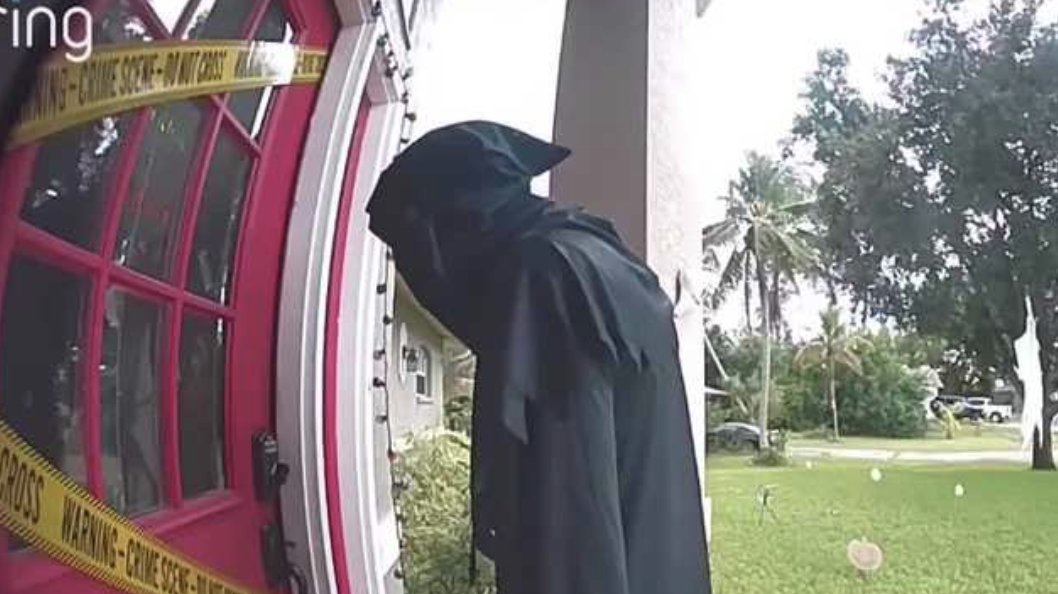
Photo: doorbell camera footage, via WMUR.
Russia: Moscow and Voronezh
Moscow and Voronezh. Mayor Sobyanin reported six drones downed on the approaches to Moscow Saturday morning, with no casualties reported, and Sheremetyevo again briefly suspended flights while Vnukovo and Domodedovo ran under restrictions, so check any flight today. Voronezh region downed 12 drones overnight; debris damaged eight private houses and several cars, with no one hurt (RIA; Interfax; AiF Voronezh).
Bottom line
Binance’s breach turned out wider than one laptop, Sunday’s planned withdrawal restart is the next test, and Aave showed DeFi can pull an emergency brake. In Health, beetroot for soreness, creatine through rehab, and weekend workouts count. Stocks are in an AI slump, data centers and plate readers are the local fights, and today is the last day of early voting. Mind the doorbell tonight: it might be the Reaper.