Morning digest: November 2, 2026
Binance’s first full day of reopened withdrawals saw a net $3.64 billion leave, about 2% of customer assets, and no run. Bitcoin is back near $78,600. Health leads with a longevity cohort of adults 65 and older, where diet quality, not just eating plants, tracked with survival, plus a Cell mouse study on taurine and age-related inflammation. Locally, NOVEC bills just went up about $13 a month, and Election Day is tomorrow. Science has a curious idea about why your right brain moves your left hand. And a speedrunner broke the Super Mario Bros. world record while dressed as Mario.
Blockchain: Binance’s first day back, Hong Kong’s settlement rail
Binance’s first withdrawal day: $3.64B net outflow, no spiral. Binance reopened withdrawals at 06:00 UTC Sunday (1 a.m. ET) after a roughly 45-hour freeze following last week’s ~$6.3 billion hot-wallet theft. Between 06:00 and 15:30 UTC it processed $4.649 billion of withdrawals against $1.01 billion of deposits, a net outflow of about $3.64 billion, or 2.1% of the $171 billion in customer assets in its Oct. 28 reserves data, and it says withdrawals have since slowed. All 15 phase-one networks (including BTC, ETH, SOL, XRP, TON, Sui and Zcash) were open by 12:36 UTC, with other networks still being tested. Withdrawals now leave from newly generated wallets that Binance added to its proof-of-reserves list, so verify addresses only on Binance’s own proof-of-reserves page. It says it has replaced about 95% of the stolen assets (its own figure), and the updated zero-knowledge proof of reserves is due Nov. 2–3. Trackers like DefiLlama show about $6.1 billion leaving Binance-linked addresses in 24 hours, but that count includes internal transfers (CNBC; CoinDesk; BBC; Binance).
Bitcoin back near $78.6K, third straight up day. Bitcoin rose about 1% in Asian trading after dipping to about $77,600 late Sunday. Ether is just above $2,300 and BNB about $713; Zcash led the majors, up 3% to nearly $1,280 ahead of this week’s upgrade. This week’s catalysts: Tuesday’s midterms (which decide who controls crypto legislation), Circle’s earnings Wednesday and Friday’s jobs report (CoinDesk; CoinDesk week ahead).
Hong Kong takes tokenized settlement to 24/7 real money. At Hong Kong FinTech Week, the HKMA (Hong Kong’s de facto central bank) said Project Ensemble, its pilot for settling tokenized deposits and assets in tokenized central bank money, now supports real-value transactions around the clock. It has completed trial secondary-market and repo trades of tokenized Exchange Fund Bills (short-term government debt) and says it will soon add licensed stablecoins to the trials, naming no issuers or dates. That puts regulated stablecoins on the same rail as bank money and government paper (HKMA; Cointelegraph).
HSBC’s Hong Kong dollar stablecoin hits 50,000 users in about ten days. HSBC RedCoin (RCHKD) is a licensed, 1:1 Hong Kong dollar-backed token that lives inside HSBC’s PayMe app rather than a separate crypto wallet. It went live Oct. 23 for peer-to-peer transfers and payments at more than 100,000 PayMe merchants; CEO Georges Elhedery gave the user count at FinTech Week. Embedding the token in an app people already use looks like the fastest adoption route for bank stablecoins so far (Crypto Briefing).
Briefly:
- Premia vaults on Arbitrum drained. Early Sunday an attacker used flash loans to create empty option pools and buy options from six Premia vaults, locking their collateral into pools the attacker controlled, then withdrew it. Estimates run from about $400,500 to $464,600, with The Defiant at about $437,000; no key compromise is reported, and Premia hadn’t commented at last check (The Defiant; Coindaro).
- Fake “SKR Claim” app in Solana Mobile’s store. A malicious app sat in the dApp Store’s Spotlight for about an hour after unauthorized access to Solana Mobile’s publishing portal; the company removed it and patched a linking bug, and hasn’t disclosed installs or losses (Solana Mobile; TSN).
- Zcash NU7 makes blocks three times faster. Activation is at block 3,543,405, expected around 00:50 UTC Nov. 6 (Wednesday evening ET). Block time drops from 75 to 25 seconds with daily issuance unchanged, 60% of fees go to a reserve, and funds left in the legacy Sprout pool become unspendable, so move them first. Nodes need Zebra 7.0.0 or Zakura 1.7.0 (ZIP 259; Zebra 7.0.0).
Health: diet quality at 65+, taurine in mice, social life and the aging brain
Adults 65+: plant diet quality, not just plants, tracked with survival. In the Chinese Longitudinal Healthy Longevity Survey, a cohort rich in the oldest-old, 5,872 adults 65 and older with early cardiovascular-kidney-metabolic syndrome were followed for a median of nine years (2,870 deaths). Each 1-point rise in a healthful plant-based diet score went with 1.1% lower mortality, and the top quartile had 13.2% lower mortality than the bottom (HR 0.868); the “unhealthful” plant score’s top quartile had 19.2% higher risk (HR 1.192). The overall plant-based score wasn’t independently linked. How to use it: favor whole grains, fruit, vegetables, nuts, legumes and tea over refined grains, sugary drinks and sweets, even late in life. Limits: observational, one baseline food questionnaire, older Chinese adults with metabolic risk (Frontiers in Nutrition).
Older adults: games and community groups beat friends-only socializing. In 2,672 Chinese adults 60 and older (CHARLS), people whose social life centered on games and community activities had better intrinsic capacity, a combined score of cognition, mobility, vitality, senses and mood, than those who mainly socialized with friends (friends-only OR 0.742, about 26% lower odds of a better rating). How to use it: mix mentally engaging group activities, such as cards, chess or community groups, into your social life. Limits: cross-sectional, self-reported, no frequency given (BMC Public Health).
Sedentary adults: VR exercise sharpened focus most. In a small RCT (33 sedentary adults), eight weeks of supervised exercise three times a week improved concentration and hand reaction time, and the VR-based version beat traditional exercise on both; balance didn’t change. How to use it: if you’re inactive, three sessions a week helps attention, and a game format that also works the brain may add a bit more. Limits: tiny pilot, retrospectively registered (BMC Sports Science, Medicine and Rehabilitation).
Fatty liver: lifting cut liver fat best. A meta-analysis of 41 studies (1,517 people with MASLD, a clinical group) found exercise alone lowered liver fat: resistance training ranked best (SMD −0.77), then moderate aerobic exercise (SMD −0.50), while HIIT showed no clear effect. Weight and body fat barely moved, so the scale is a poor guide to liver benefit. Limits: low to very low certainty, no dose given (European Journal of Gastroenterology & Hepatology).
Briefly:
- Knee osteoarthritis: mix cardio and strength. A network meta-analysis of 35 RCTs (3,808 patients, clinical) found up to 12 weeks of combined aerobic and resistance exercise gave the biggest pain relief (SMD −0.94) and the best function and quality-of-life gains; every exercise type helped. Low certainty (JOSPT).
- Dairy didn’t boost home strength training at 78. In a 12-week pragmatic RCT (54 Japanese adults, mean age 78), adding about 10–15 g a day of dairy protein to home resistance training three times a week added no strength, function or body-composition benefit; training was the active ingredient. Small, open-label, partly industry-supplied (BMC Geriatrics).
- Asparagus-stem extract and memory: an early signal. A manufacturer-run 12-week RCT (66 healthy adults 40 and older) found 300 mg a day of the extract ETAS improved composite memory vs placebo (+12.8 points at 6 weeks, +9.0 at 12, p = 0.048). Small, all authors employed by the maker, not replicated (Journal of Nutritional Science and Vitaminology).
General and local
Futures bounce after a rough October. Early Monday, Nasdaq-100 futures were up about 0.8% and S&P 500 and Dow futures about 0.4–0.5%, after an AI-led selloff left the Nasdaq Composite down 5.2% in October. Oil fell on reports the US and Iran are seeking a diplomatic resolution, with US crude dipping below $100. ISM manufacturing (54.7 expected) is out this morning, Apple reports after the close, and the October jobs report is Friday (Yahoo Finance; TipRanks).
NOVEC bills up about $13 a month. NOVEC’s increase took effect Nov. 1: an updated power cost adjustment plus a 5% distribution-charge bump add about $13.35 a month to a typical 1,000-kWh home bill. NOVEC says data-center infrastructure costs aren’t passed to residential members (Hoodline).
Warehouse zone grows beside Bristoe Station. Prince William supervisors voted unanimously Oct. 20 to add nine parcels near Bristow and Nokesville roads, next to Bristoe Station Battlefield park, to the E-Commerce Overlay District, despite residents’ worries about truck traffic, noise, lighting and stormwater (Manassas Journal).
Briefly:
- Election Day is tomorrow. Polls are open 6 a.m. to 7 p.m. Tuesday, Nov. 3 (Prince William Times).
- No PWCS classes today or tomorrow. Students are off for parent conferences and a teacher workday (Prince William Living).
- Burke Lake crash turns fatal. The driver hurt in Saturday’s three-vehicle crash at Fairfax County Parkway and Burke Lake Road, Daniel Locke Jr., 82, of Fairfax Station, has died; police say speed is preliminarily a factor and alcohol isn’t (FCPD).
Lighter note: “It’s-a me, world record.” Super Mario Bros. speedrunner Niftski, 22, streamed on Halloween dressed as Mario, doing the voice and trying to keep a glued-on mustache in place, and broke his own any% world record by 0.33 seconds, to 4:54.299, two frames from a perfect run. Moments before, he said, “Hopefully I don’t get this today because that would be very stupid.” Afterward: “WHAT IN THE WORLD I CANNOT BREAK CHARACTER!” (Kotaku).
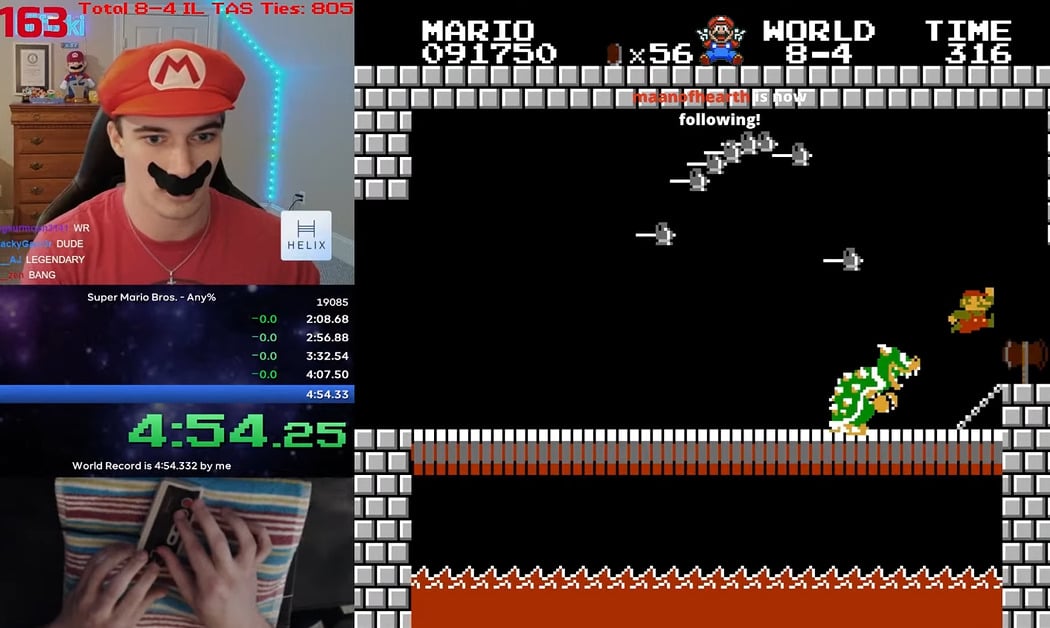
Image: Niftski’s Halloween stream, via Kotaku.
Science
Curious idea: why your right brain moves your left hand. In a Hypothesis & Theory paper, Wessendorf and Wang of the University of Minnesota note that in every vertebrate reported, each visual field is wired to the opposite side of the brain, that in most land vertebrates touch and hearing cross over too, and that early amniotes already had crossed motor pathways. They propose that when the mammalian neocortex evolved, it simply adopted the crossed layout already in place, avoiding the “wiring cost” of rebuilding those circuits. It’s a hypothesis, not a proven finding. The paper also quotes pitcher Bill Lee: “If the right side of the brain controls the left side of the body, then only left-handed people are in their right minds” (Frontiers in Neuroanatomy).
A giant virus carries a working potassium channel. In PNAS, a team led from TU Darmstadt reports that a giant virus infecting a marine alga encodes Kpov, a 178-amino-acid two-pore-domain (K2P) potassium channel, far smaller than any known in complex cells, and that it conducts potassium in artificial membranes. Bacteria don’t have K2P channels, so the authors suggest such viruses may have helped bring them to complex cells, including the ones that set resting voltage in our neurons and heart; that part is a hypothesis (PNAS; TU Darmstadt).
Russia: Moscow and Voronezh
Voronezh and Moscow. Voronezh region downed 20 drones overnight; no one was hurt, but debris damaged the facades and windows of two private houses. Just after midnight, Domodedovo and Zhukovsky suspended operations and Vnukovo went to clearance-only, so check any flight (Kommersant; MK Voronezh; RIA).
Bottom line
Binance’s reopening drew a big but orderly outflow, and the proof of reserves due by Tuesday is the next checkpoint. Eat the healthy kind of plants, keep lifting, and treat taurine as a promising mouse result, not a supplement plan. NOVEC bills are up, Election Day is tomorrow, and the Super Mario Bros. world record now belongs to a man in a glued-on mustache.