Morning digest: November 4, 2026
Democrats won both houses of Congress, and in Virginia Mark Warner, Suhas Subramanyam and Eugene Vindman all won while all three constitutional amendments passed. Manassas City Council is now all-Democratic, and a School Board seat came down to 13 votes. Binance explained how its $6.3 billion hack happened: a tampered Homebrew package and a fake job interview. Bitcoin dipped below $76,000 on the results, then bounced back to about $78,300. Health leads with recreational athletes, where heavy squats made sprinters faster but jump squats didn’t, and older adults, where light leg work with blood-flow cuffs matched heavy lifting. Science has a curious idea: a 1770 solar storm recorded in Chinese chronicles may have been about 30% stronger than Carrington. And two robots campaigned at a Dallas polling place.
Blockchain: how Binance was breached, bitcoin’s election bounce
How Binance’s $6.3 billion hack happened. Binance’s security report on the Oct. 29 theft says the attackers worked on it for months. In June a wallet DevOps engineer installed a tampered Homebrew package while looking for an AI coding tool. In September a second engineer was infected through a coding test in a fake job interview. The attackers then used an internal AI tool to reach other wallet-team machines and push a malicious script that signed the withdrawals. The new figures: Binance says it has replenished 98% of the $6.34 billion, about $2.85 billion is frozen or intercepted, and users have pulled a net $4.72 billion since withdrawals reopened. The lesson for everyone is that AI developer tooling has become a way into key-signing systems. Binance’s wider proof-of-reserves snapshot runs today; the zero-knowledge proof takes about 40–50 hours (CNBC; Axios; The Block).
Bitcoin’s V-shaped election night. BTC briefly fell below $76,000, a six-week low, as the Democratic sweep came in, then recovered to about $78,300; ether is near $2,320. Analysts read a Democratic Congress as a possible slowdown for crypto market-structure legislation, and Sherrod Brown’s win over Jon Husted in Ohio is a setback for the crypto PAC Fairshake (CoinDesk).
A French bank allegedly lost $133 million or more. Onchain investigator ZachXBT says an attacker drained USDC and USDT from Crédit Mutuel Arkéa’s accounts on several centralized exchanges over multiple days, then laundered it through ETH, instant-swap services and Monero. He doesn’t think North Korea’s Lazarus Group did it. The bank hasn’t commented, so this is unconfirmed (The Block).
BTCPay Server hot wallets drained. Attackers took about $1.62 million in BTC and LTC from merchants running the open-source, self-hosted payment software at version 2.4.1 or older, in 682 sweeps since about Nov. 1. Fix: move to 2.4.7 on a fresh server with a new wallet and treat the old machine as compromised (The Hacker News).
Morgan Stanley signs up for DTCC tokenization. Morgan Stanley says it’s among the first banks using DTCC’s tokenization service for U.S. stocks and Treasuries, which DTCC launched Oct. 28; no completed transaction or volume was given (CoinDesk; DTCC).
Briefly:
- SEC staff call Canton Coin a “digital commodity.” A Corporation Finance no-action letter says staff won’t recommend enforcement over the Canton Network token’s programmatic minting to validators and app providers without registration; it covers only Canton’s facts but is a template (SEC).
- CFTC clears perpetual futures on single U.S. stocks. Chair Michael Selig says no-expiry “perps” on individual stocks can list on CFTC-registered exchanges also notice-registered with the SEC, as security futures; no venue or start date yet (CFTC).
- Liquid’s LBTC back to 1:1. The Liquid Federation says bitcoin reserves fully back LBTC again after September’s exploit; The Block reports Blockstream supplied the remaining bitcoin (The Block).
- Swiss franc stablecoin CHF-S on Solana. Zug’s Safirum issued it with Token-2022 rules that block any wallet without KYC/KYB, reserves at Berner Kantonalbank and Banque Richelieu; the first public stablecoin under FINMA’s whitelisting route, with a CHF 10,000 first mint (finews).
- Cross River tokenizes loans on Arbitrum. With Offchain Labs, a proof of concept is done and production is targeted for early 2027 (Cross River).
- LayerZero tightens ZRO security. STG holders can convert to ZRO through Dec. 15; ahead of Zero mainnet, ZRO contract ownership moves to its OneSig system and the required DVN threshold rises to 4 of 4 (LayerZero).
- NEAR votes to cut inflation. Maximum annual issuance falls from 2.5% to 1.6% over 24 months, pending Security Council review, a 90-day grace period and a validator upgrade (The Block).
- Aztec ships Tierra V6. The Ethereum L2 says the upgrade fixes earlier security issues and doubles private-proof speed (project-reported) (The Block).
Health: heavy squats for sprinters, cuffs for older legs
Recreational sprinters: heavy squats help, jump squats don’t. In an 8-week RCT, 58 recreationally active adults not used to strength training all did two weekly sessions of 6 × 25 m sprints, plus three weekly sessions of either heavy squats (4 × 4 at ≥85% of 1RM), moderate squats (3 × 8–12 at ~70–80%), bodyweight squat jumps, or nothing. Both squat groups cut 25-m sprint time by about 0.1 s (−0.11 and −0.10 s) and raised Wingate power about 7% (+6.6%, +6.9%); heavy squats also improved running economy 2.5%. Jumps added nothing over sprinting alone. Limits: about 15 per arm, exploratory statistics (Journal of Strength and Conditioning Research).
Over 50: light leg work with cuffs matched heavy lifting. A meta-analysis of 25 RCTs (819 adults 50+) found low-load training with blood-flow-restriction cuffs gave strength and function gains no different from heavy lifting, about 3–4 more chair stands in 30 seconds and a Timed Up and Go about 2 s faster versus no training; walking with cuffs beat plain walking. Useful if heavy loads hurt your joints. Limits: small trials, cuff settings not given, and BFR needs proper fitting and screening, e.g. for clot history (BMC Geriatrics).
Lifters: 3.2 g/kg of protein didn’t measurably hurt kidneys. In a 16-week 2×2 RCT, 44 resistance-trained men (about 26) ate 1.6 or 3.2 g/kg/day while training four times a week. No kidney marker differed between intakes, though in the high-protein groups BUN and cystatin C rose and eGFR dipped. Takeaway: 1.6 g/kg already covers training, with no reason to go higher; people with kidney disease shouldn’t. Small, healthy young men only (JISSN).
High blood pressure: weekly minutes beat session count. In a 12-week RCT (47 analyzed, ages 50–80, clinical), 120–160 minutes a week of combined aerobic and strength training at moderate effort (RPE 4–6 of 10) cut 24-hour systolic blood-pressure variability whether done in two or four sessions a week. No non-exercise control (Frontiers in Rehabilitation Sciences).
Briefly:
- Pickup soccer for chronic disease. A meta-analysis of 17 trials (588 people, clinical) found recreational football raised VO2peak (SMD 0.70) and cut resting heart rate, diastolic pressure, triglycerides and cholesterol, with 83% attendance; low to very low certainty (Frontiers in Public Health).
- Minimally processed food shows up in your blood. In 6,010 Whitehall II civil servants followed 18–20 years (general population, observational), a blood-metabolite signature of minimally processed eating went with 40% lower type 2 diabetes risk and 19% lower cardiovascular risk, while the ultra-processed signature went with about 20% higher risk of each (BMC Medicine).
- Short sleepers with prediabetes: coaching helped sleep, not sugar. In an 8-week RCT of 196 adults, sleep coaching improved sleep quality and sleepiness but not glucose or weight loss; a link of about 1.3 lb more weight lost per hour-earlier bedtime is exploratory, not causal (PubMed).
- A vascular “aging” powder: early signal only. In a 6-month double-blind RCT (61 healthy adults, 43 finished), a proprietary multi-ingredient powder improved flow-mediated dilation by 2.9 points, cut pulse-wave velocity by 1.18 m/s and systolic pressure by 6.1 mmHg versus control; ingredients and doses aren’t listed, so it’s not a buy signal (European Heart Journal Open).
General and local: a Democratic wave
Democrats take Congress. Democrats flipped seven Senate seats, Iowa, Kansas, Maine (Collins lost), North Carolina, Ohio, South Carolina and Texas (Talarico beat Paxton), for at least a 54–44 majority, with Alaska and Mississippi uncalled. In the House they picked up at least 18 seats for at least 231–141 as counting continues. They also gained four governorships, giving them a majority of governors for the first time since 2010 (Ballotpedia; CBS News).
Virginia: Warner, Subramanyam, Vindman win; all three amendments pass. Mark Warner won a fourth term, which he says will be his last, with 60.95%. In VA-10, which covers Manassas, Suhas Subramanyam won 61.4% to 36.6%; in VA-7, Eugene Vindman won 59.7% to 37.8%; in Fairfax, Walkinshaw and Beyer won easily. Elaine Luria ousted Jen Kiggans in VA-2, while VA-1 and VA-5 were still uncalled at last count. The amendments on reproductive rights (62.3% yes), same-sex marriage (57.3%) and voting-rights restoration (56.5%) all passed, with majorities in PWC and Manassas; they take effect Jan. 1, though challenges to certifying Questions 1 and 2 are pending (Virginia Mercury; NBC4; Axios).
Manassas: an all-Democratic council, and a 13-vote School Board race. Dianne Lane, Jill Spall and Helen Zurita won the three City Council seats, and the council’s only Republican, Theresa Coates Ellis, finished fourth. On the School Board, Lisa Anne Stevens, Marcus Still and Murina Dove won, and incumbent Sara Brescia trails by 13 votes with provisional and late absentee ballots still out. Sonia Vásquez Luna won the HD-20 special with 69.6% and leaves City Council for Richmond, and Dumfries re-elected Mayor Derrick Wood. Results are unofficial (Potomac Local; Potomac Local; InsideNoVA).
Markets shrug off the sweep; AMD beats. Futures first fell, with the Nasdaq-100 down as much as 2.4%, then recovered: by 3:13 a.m. the Dow was +0.46%, S&P +0.15% and Nasdaq-100 +0.26%, though hyperscalers slipped in Europe on fears of tougher AI and data-center rules. Tuesday the S&P 500 rose 0.36% to 7,568.92 and the Nasdaq 0.83%, while the Dow fell 0.38%; the 10-year yield ended at 4.95%. September job openings rose to 7.52 million, a four-month high. AMD’s revenue of $13.38 billion and adjusted EPS of $2.09 beat, data-center sales nearly doubled, and the stock rose about 7% after hours. ADP and ISM services are out today; the October jobs report is Friday at 8:30 a.m. (Reuters via Investing.com; The Closing Print; AMD).
Lighter note: robots can’t vote, but they can campaign. Two humanoid robots wearing signs ran around the parking lot of a Dallas polling place. The signs read “Talarico changes his mind more than I change my batteries” and “Say no to Talafreako.” Their owner went viral in May for buying his robot a Southwest seat, after which the airline banned robots. Talarico won anyway (FOX 4).
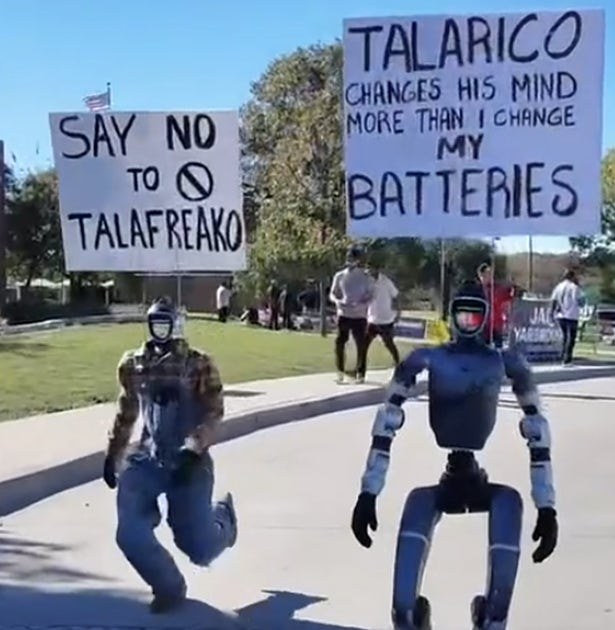
Photo: FOX 4 Dallas-Fort Worth, via FOX 4.
Science
Curious idea: was a 1770 solar storm bigger than Carrington? Yuan and colleagues reconstructed the geomagnetic superstorm of Sept. 15–19, 1770 from 23 aurora records in Chinese regional chronicles, checked against Japanese records and a sighting by Captain Cook’s Endeavour crew. The southernmost, from Hunan, describes “hundreds of rays of emerald-white light”; the green color puts the auroral edge near 20.4° magnetic latitude, against 28.3° for Carrington in 1859. Their estimate: a storm strength (Dst) of about −1,319 nT versus about −1,025 nT for Carrington by the same method, roughly 30% stronger, with a rough recurrence of once in about 14,000 years. It’s an empirical estimate, not a settled finding: the confidence ranges overlap, it rests on a fitted model and readings of 250-year-old text, and the authors want tree-ring carbon-14 checks. If it holds, Carrington isn’t the ceiling for storms that threaten power grids and satellites (Frontiers in Astronomy and Space Sciences).
Russia: Moscow and Voronezh
Drones downed near Moscow and over Voronezh. Sobyanin says 8 drones were shot down approaching Moscow this morning, with no casualties reported. In Voronezh, Gov. Gusev says 16 drones were downed over the city and region; debris broke a house’s windows and damaged a car, and no one was hurt. The all-clear came at 10:18 Moscow time (Interfax; RIA Novosti).
Bottom line
Democrats now control Congress, crypto legislation may slow, and Virginia’s three amendments passed. Manassas has an all-Democratic council and a School Board seat hanging on 13 votes. Binance’s breach started with a fake job interview and a bad Homebrew package, so be careful what your developers install. Add heavy squats if you sprint, try cuffs if heavy weights hurt, and eat food that looks like food. Somewhere in Dallas, two robots are recharging.