Morning digest: November 6, 2026
Bitcoin gave back its whole post-election bounce, falling to about $76,000 as a Nasdaq rout spilled into crypto and wiped out more than $1.1 billion in leveraged bets. Zcash’s NU7 and Base’s Denim upgrades are both live, and Ethereum’s Glamsterdam fork is delayed again. Health leads with a 97-study meta-analysis of caffeine in team-sport athletes, plus lifting for back pain and sleep apnea and a mouse study tying bone force-sensing to longer life. In Virginia, Wittman and Perriello conceded, and the Dow lost 1,833 points ahead of this morning’s jobs report. Science has the coldest temperature ever made, on China’s space station, and a toothbrush that zaps bacteria. And a Connecticut town’s top official helped catch a runaway emu.
Blockchain: bitcoin’s rebound erased, two upgrades live
Bitcoin erases the post-election rebound. BTC fell about 5–6% Thursday to roughly $75,700–$76,000 as a Nasdaq selloff spilled into crypto, then edged back above $76,000 early Friday. Ether dropped more than 7% toward about $2,250. Roughly $1.1–1.3 billion in leveraged positions were liquidated in 24 hours, mostly longs. U.S. spot bitcoin ETFs saw about $430 million in net outflows Thursday (Fidelity’s FBTC about $200 million, BlackRock’s IBIT about $105 million), reversing Wednesday’s small inflow (CoinDesk; The Block).
Ethereum delays Glamsterdam again. The Ethereum Foundation says auditors at Chainsecurity found existing projects relying on assumptions that EIP-8037 and EIP-8038 (gas repricing and state charging) would break. Core developers won’t fork the Hoodi testnet until that’s resolved, and the EF is asking builders and auditors to check eight listed invariants (Ethereum Foundation).
Zcash NU7 is live. The upgrade activated at block 3,543,405, around 02:34 UTC Friday (9:34 p.m. Thursday ET), cutting block time from 75 to 25 seconds. Rewards per block shrink by the same factor, so issuance, the 21 million cap and the halving calendar hold. 60% of fees now go to a public reserve, with 40% to miners. Old version-4 transactions are invalid, leaving about 12,224 ZEC in the legacy Sprout pool unspendable (CoinDesk; The Block).
Base Denim is live, with hiccups. Coinbase’s layer 2 now makes five canonical blocks a second (200 ms), replacing Flashblocks, and adds millisecond timestamps for contracts. Base’s status page reports periodic transaction-inclusion delays and an elevated rate of empty blocks under investigation. Apps that count blocks as time now run about 10× faster in wall-clock terms (Base; Base status).
“CLARITY is dead,” says Paradigm’s policy chief. Justin Slaughter told Unchained the market-structure bill won’t pass in the lame duck. House Financial Services Democrats are reportedly drafting their own: stricter ethics on officials’ crypto holdings, tougher DeFi rules, consumer protections like 24-hour payouts and independent audits, and more oversight shifting to the SEC. He flagged DeFi as the piece to watch (Unchained).
Gate’s “Proof of Security.” After the Binance hack, Gate published a Nov. 4 snapshot: 88.26% of assets in cold storage, 11.74% hot, with cold wallets alone covering 104.58% of customer assets. A third-party audit of the figures is still underway (Gate; CoinDesk).
Briefly:
- Loopscale pauses. The Solana lender says its APIs took more than 30,000 malicious requests a day for about a week, aimed at older SOL and USDC Genesis vaults; it says those vaults were made whole and users lost nothing (Loopscale; Web3 Business News).
- Hyperliquid treasury firm seeks a U.S. futures license. Hyperliquid Strategies’ HypeStrat Markets applied to become a CFTC-registered futures commission merchant to offer permissioned HIP-3 markets to U.S. clients; approval and timing are uncertain (CoinDesk).
- A MiCA euro token on XRPL. Slovenian e-money issuer Dinaro and GateHub launched EURGH, a 1:1 euro token on XRPL and Xahau, redeemable at par with SEPA rails (GateHub).
- American Bitcoin’s paper profit. The Eric Trump–linked miner reported $126 million Q3 profit, mostly a roughly $197 million non-cash gain on its bitcoin; mining revenue fell to about $63 million on 891 BTC at a cash cost of about $42,100 per coin (CoinDesk).
- IREN quits bitcoin mining. Mining revenue dropped 58%, and the company aims to finish converting its capacity to AI cloud by Dec. 31 (The Block).
Health: caffeine for athletes, lifting for back pain and sleep
Caffeine in team-sport athletes: real but small, and no proven dose. A meta-analysis of 97 studies (1,516 athletes) found acute caffeine improved sprints, repeated-sprint ability and agility (g ≈ 0.34 each), power (g = 0.33), jumps (g = 0.29), upper-limb skills (g = 0.25), match physical performance (g = 0.23) and strength (g = 0.20). It didn’t help lower-limb skills, match technical play, endurance or perceived fatigue. Doses ranged from 3 mg/kg or less to 9 mg/kg, but no dose came out best after correction, so the authors say there’s no evidence for an optimal protocol (Frontiers in Nutrition).
Light weights to failure matched heavy ones. In a 6-week RCT of 22 untrained young men (11 per arm, knee extensions three times a week to failure), low-load and high-load training gave similar estimated 1RM gains (+35.9 kg vs +32.5 kg) and similar quadriceps growth; the light group just lifted more total volume (58,119 vs 45,598 kg). If heavy loads bother your joints, lighter sets to failure work too. Limits: one exercise, small, untrained men only (BMC Sports Science).
Chronic low back pain: weights beat cardio. In an 8-week RCT (38 adults with nonspecific chronic low back pain, three sessions a week, clinical), periodized resistance training beat periodized aerobic training on pain (−2.71 points on a 10-point scale, adjusted), disability, fear of movement and trunk strength and endurance. Small, single-center, no long-term follow-up (Physiotherapy Research International).
Sleep apnea: lifting improved sleep quality. In 25 adults with moderate-to-severe obstructive sleep apnea (average BMI 36.1), 8 weeks of resistance training three times a week improved the Pittsburgh sleep score by 3.2 points vs essentially no change in controls, with better quality-of-life scores; daytime sleepiness didn’t change. It’s a small secondary analysis and an add-on, not a replacement for CPAP (Sleep and Breathing).
Over 60: balance training ranked best for sleep. A network meta-analysis (39 studies, 3,198 adults 60 and older) ranked balance training top for self-rated sleep quality (−2.58 points), ahead of aerobic (−1.47), multicomponent (−1.30) and resistance training (−1.17); flexibility had too few studies to rank (Journal of Physical Activity and Health).
Brief mindfulness barely moves cognition. A meta-analysis of 66 studies found short mindfulness sessions improved executive function right afterward by a tiny g = 0.09, and the authors call the practical relevance “very limited.” That’s one-off lab sessions, not weeks of practice (Neuropsychology Review).
Bone loading and longer life, in mice. A Cell Metabolism study found that deleting the force-sensing channel Piezo1 in bone cells sped whole-body aging in mice, while mechanically loading the shinbone of 20–24-month-old mice extended lifespan 9.4% (about 79.5 days) and improved healthspan. It points to bone as one way physical loading talks to aging biology, but it’s a mouse study with no tested human dose or exercise prescription (Cell Metabolism).
General and local: concessions, a selloff, a loose emu
Wittman and Perriello concede. The AP called VA-1 for Shannon Taylor (D), 51.06% (208,052) to Rob Wittman’s 48.70% (198,429), outside the 1% recount threshold; Wittman conceded and will serve out his term. In VA-5, John McGuire (R) held on, 50.18% (181,271) to Tom Perriello’s 48.02% (173,438), and Perriello conceded. Certification is Dec. 7 (VPM; VPM).
Teen charged in fatal Yorkshire crash. A 16-year-old Manassas boy faces two counts of involuntary manslaughter after the Oct. 24 crash at Leland Road and Maplewood Drive that killed Jose E. Lovo, 70, and Guadalupe Alvarez de Lovo, 54. Police have added patrols; a county traffic study of the Maplewood neighborhood ($80,000) hasn’t started and is due by June 2027 (Manassas Journal).
Dulles land pitched for data centers. The Metropolitan Washington Airports Authority is marketing two parcels at Dulles, about 181 and 19 acres, for possible data centers, which would need federal approval near active runways. MWAA also plans nearly 3 million square feet of industrial space around the airport (FFXnow).
AI selloff wipes out the midterm rally. The Dow fell 1,833.06 points (−3.44%) to 51,523.06, the S&P 500 fell 4.36% to 7,353.73 and the Nasdaq fell 5.52% to about 24,315, a correction. Nvidia fell about 9% and Tesla about 11%. WTI oil rose about 2–3% to around $90.50. The October jobs report is out at 8:30 a.m., with economists expecting about +59,000 jobs and unemployment near 4.2% (AP; CNBC; CNBC).
Briefly:
- Manassas School Board, 13 votes. Murina Dove still leads Sara Brescia 5,941 to 5,928; late mail ballots count if they arrive by noon today (Potomac Local).
Lighter note: the first selectman caught the emu. A nearly 5-foot, 100-plus-pound emu ran loose for a couple of hours Wednesday on Thompson Hill Road in Thompson, Connecticut, right off I-395, before animal control cornered it in a backyard. Both officers are new: Nicole Raymond started in March, and her partner, Nicholas Donohue, is also the town’s first selectman, who recently got animal control certified. It was the town’s first emu call ever. “Emus have a very long and delicate neck structure,” Donohue said. They hoisted it into a van, and the owner picked it up a few hours later (FOX61; WTNH via WPRI).
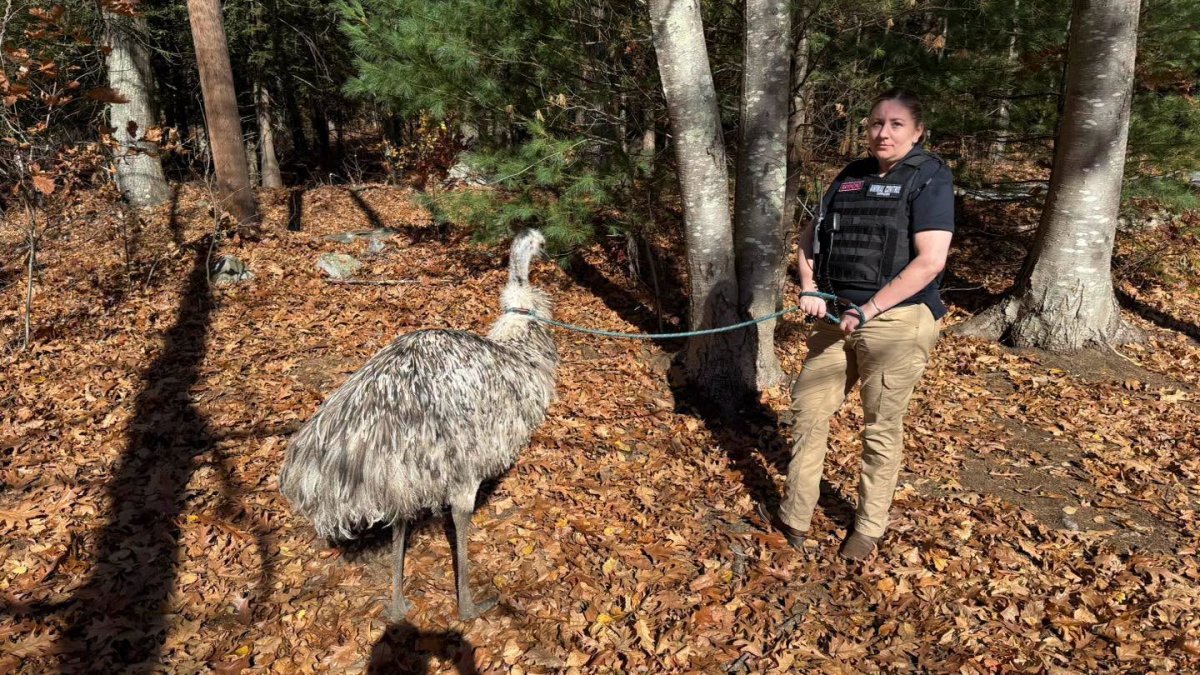
Photo: Town of Thompson, via NBC Connecticut.
Science: the coldest place ever, and a zapping toothbrush
The coldest temperature ever, in orbit. Aboard China’s Tiangong space station, physicists cooled a rubidium Bose–Einstein condensate to about 9.7 picokelvins, less than ten-trillionths of a degree above absolute zero and about four times colder than the previous record of about 52 pK on the ISS in 2020. Laser traps cooled about 2 million atoms down to about 2,000 at 3 nanokelvins, then let them spread out until they crawled at under 200 micrometers per second. In free fall, the cloud can be watched for about 7 seconds, which experts say may matter more than the record, because it’s long enough for precise tests of whether gravity pulls equally on different atoms (Science; Science news).
A toothbrush that makes its own electricity. Peking University researchers made bristles from a stretched, heated polymer that gives off a charge when it bends; the charge creates reactive oxygen in saliva that damages bacteria, with no battery. It didn’t damage teeth or harm human cells in tests, but long-term safety, cost and whether it really cuts more plaque are unproven. It could be the manual toothbrush’s first radical redesign in more than 1,000 years (Nature).
Russia: Moscow and Voronezh
Domodedovo pause, Voronezh alert. Domodedovo briefly restricted flights around 01:38 Moscow time over a drone threat and quickly returned to normal. Voronezh had a roughly three-hour drone alert Friday morning (Interfax; AiF Voronezh).
Bottom line
Crypto and tech fell together, so watch the 8:30 jobs number for the next move. Zcash and Base just got much faster, while Ethereum’s next fork waits on safety checks. If you play sports, caffeine helps sprints and jumps a little; for back pain or sleep apnea, try lifting; past 60, add balance work. Virginia’s House races are settled. And in Connecticut, the town’s top official now has an emu capture on his résumé.