Morning digest: November 16, 2026
Bitcoin logged a sixth straight weekly loss and trades around $64,000, attackers hijacked bitcoin miners’ hashrate through Luxor’s fleet software, and DBS and J.P. Morgan’s Kinexys went live with round-the-clock tokenized-dollar transfers between Singapore and the U.S. In health, fast, light “ballistic” lifting nudged up hip bone density after menopause where heavy, slow lifting didn’t. Nasdaq futures are down about 1% ahead of Nvidia earnings, U.S. flight cancellations fell to 491 by 5 a.m., and SpaceX caught a Starship returning from orbit with its launch tower. About 600 drones flew toward Moscow overnight, briefly restricting Vnukovo and Sheremetyevo.
Blockchain: a sixth losing week, hijacked miners and live tokenized dollars
Bitcoin’s sixth straight weekly loss. BTC fell below $62,000 on Saturday, taking November’s drop to about 17%, and has recovered to about $64,000 to $64,500; ether is near $1,800. A strong dollar (DXY above 103) and a 10-year Treasury yield above 5.1% are weighing on risk assets, and Strategy, the largest corporate bitcoin holder, was down about 8% premarket. This week brings U.S. retail sales, Nvidia earnings and, on Wednesday, minutes of the Fed’s October hold at 3.75% to 4%; strong data could feed the rate-hike bets that have been pressuring crypto. (CoinDesk · CoinDesk Week Ahead)
Miners hijacked through Luxor’s software. Attackers compromised Commander, Luxor’s fleet-management tool, and pointed machines in just over a dozen customer accounts at the OCEAN pool, so owners paid for the electricity while about $15,700 in rewards went to an attacker’s address. Luxor patched within two hours, will reimburse clients, and called it an “AI-enabled” attack without saying how. Mining-management software is a single point of control over a lot of hashrate. (CoinDesk · The Block)
Tokenized dollars move 24/7 between DBS and Kinexys. Institutions can now send tokenized U.S. dollar deposits instantly between DBS Token Services in Singapore and J.P. Morgan’s Kinexys network in the U.S., weekends included. Partior coordinates settlement and Ant International is the first client, using it for real-time treasury. One catch: transfers between Kinexys blockchain accounts and ordinary deposit accounts pause for three hours every Saturday, Eastern Time. It’s commercially live interoperability between two banks’ separate deposit-token systems. (DBS · The Block)
Briefly:
- Russia opens crypto to retail Tuesday. From Nov. 17, under a Bank of Russia ordinance, non-qualified investors can buy only BTC, ETH and USDT through regulated intermediaries, after passing a test, capped at ₽300,000 a year per intermediary; qualified investors have no cap and a wider choice. (Bank of Russia)
- HKMA and Swift test tokenized-deposit payments. The Hong Kong Monetary Authority and Swift will study linking Swift’s ledger to the settlement layer of Project Ensemble for instant, 24/7, multi-currency tokenized-deposit payments, with Bank of China (Hong Kong), Standard Chartered (Hong Kong) and HSBC taking part. (TokenPost)
- ASTER drops 32% in minutes. The token of the Aster perpetual-futures exchange fell from about $0.71 to $0.48; CEO Leonard Leung is investigating what he called “likely malicious” liquidations of highly leveraged positions. (Cointelegraph)
- Kava moves to shut its lending market. After last week’s roughly $3.8 million Kava Lend drain, Kava Chain published its response and is seeking to end the lending function. (Bloomingbit)
- Vitalik backs leanPCS for post-quantum Ethereum. Buterin says the proof approach could let Ethereum aggregate bulky post-quantum signatures and STARK proofs in the mempool, as draft EIP-8288 proposes, without first agreeing on a STARK instruction set. Still a draft with no activation date. (crypto.news)
- On-chain fund registers in Asia. Singapore fund administrator AlfaR and tokenization firm Asseto will run a “digital transfer agency” that keeps fund ownership registers on-chain, so the token record can be the official register where law and fund documents allow. (CoinTrust)
Health: lift fast, keep moving, a glass of milk
Fast, light lifting for hip bones after menopause. Clinical randomized trial (REPROOF, 109 healthy women 50 to 70, mean age 63, mostly not osteoporotic): eight months of supervised twice-weekly ballistic resistance training, fast and explosive with light loads, raised total hip bone density versus controls by 0.008 g/cm² (95% CI 0.001 to 0.014), and also helped hip and trochanter density in women with lower bone density. Conventional heavy, slow training didn’t move hip density. Adherence was 98%. Lever: if bone is the goal, add speed to your lifts. The change is small, fracture risk wasn’t studied, and 82 of 109 finished. (Bone)
Aerobic exercise, slightly better self-control. Clinical meta-analysis (9 randomized trials, 605 university students 18 to 25): aerobic programs improved inhibitory control, the ability to stop an automatic response, with a small effect (Hedges’ g −0.35, 95% CI −0.59 to −0.12; negative is better). Intensity, session length and program length didn’t change the effect, so no best dose emerged. Lever: regular cardio for sharper executive function, but expect a small gain. All nine trials were in China. (Frontiers in Psychology)
A glass or two of milk for sleep. General, mostly observational meta-analysis (25 observational studies and 4 trials): each daily serving of milk went with 15% lower odds of poor sleep quality (OR 0.85, 0.76 to 0.94) up to about two servings a day, and in the trials dairy improved sleep-quality scores (−0.49, −0.92 to −0.05). Above three servings of milk or two of dairy, the trend reversed. Lever: one or two servings of milk or yogurt a day; more isn’t better. Mostly observational, and only four trials. (Nutrition Journal)
Exercise dose for fibromyalgia pain. Clinical dose-response meta-analysis (24 studies, 1,992 women): exercise cut pain on a 0-to-10 scale by about 3 points at its peak, around 1,400 MET-minutes a week for aerobic exercise (−2.93), 550 for resistance training (−1.81) and 800 for mind-body exercise such as tai chi or yoga (−3.07). Roughly, 1,400 MET-minutes is about 350 minutes of brisk walking a week (our conversion). Doses were estimated and the credible intervals are wide. (Frontiers in Physiology)
Briefly:
- Capsaicin pill and cognition, preliminary. Clinical pilot trial (40 overweight middle-aged and older adults, 12 weeks): 200 mg a day of a capsicum extract (Capsifen) raised a total cognition score from 98 to 107 versus 105 to 106 on placebo. Only 34 finished, and the groups started unequal, so this isn’t a reason to supplement. (Nutrients)
- Astaxanthin: tiny lipid changes. Clinical meta-analysis (16 trials, 694 overweight or obese adults): the supplement modestly lowered CRP and IL-6, but LDL fell only about 1 mg/dL and triglycerides about 3 mg/dL, with no change in weight or blood pressure; certainty was low to very low. (Nutrition & Metabolism)
General and local: futures, flights and a tower catch
Nasdaq futures down nearly 1%. As of 5:08 a.m. ET, Nasdaq-100 futures were down 273 points (0.97%), S&P 500 futures down 27 points (0.36%) and Dow futures up 8 points; Nvidia slipped 2.2% premarket. Reuters ties the slide to Nvidia’s earnings and Anthropic’s market debut, both coming up. (Reuters via StreetInsider)
Flights nearly back to normal. By 5 a.m. ET, FlightAware showed 491 U.S. cancellations and about 6,513 delays, down from 2,855 cancellations and 26,195 delays on Sunday. Officials blame Friday’s stoppage on a router issue that disrupted air traffic control communications. American had the most cancellations, 149. (NBC News)
SpaceX catches a Starship from orbit. On Saturday the launch tower’s mechanical arms caught Starship’s upper stage as it came back from orbit, 22 hours after liftoff, a first that SpaceX says shows the ship can be fully reused. It flew 14 laps around Earth about 165 miles up and released 26 Starlink satellites; the booster’s engines cut off too early on the way back and it exploded in the Gulf of Mexico, so the hoped-for double catch failed. “Look at her! Baby, she’s back!” a SpaceX commentator shouted, and Musk climbed the tower and hugged the spacecraft. NASA is paying billions for Starship to land Artemis astronauts on the moon. (AP via Phys.org)
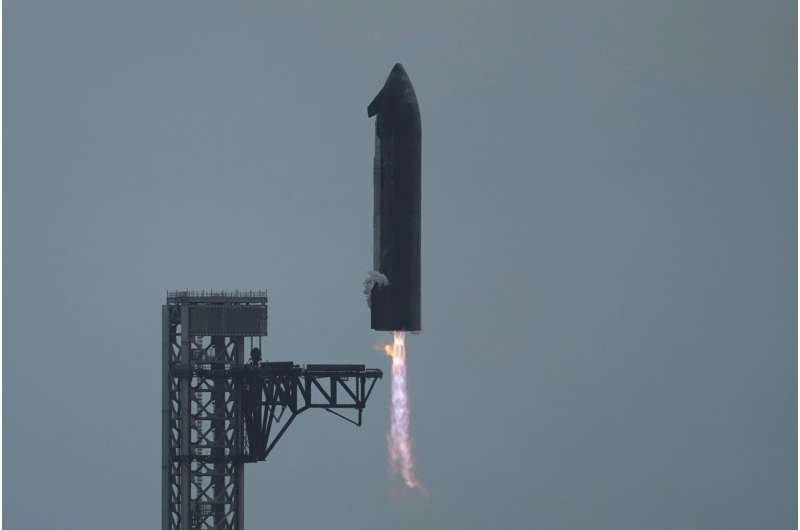
Photo: AP Photo/Eric Gay, via Phys.org.
Russia and Ukraine: Moscow airports
Drones restrict Moscow airports. Mayor Sobyanin said about 600 drones flew toward the Moscow region from 5 p.m. Sunday to 8 a.m. Monday, 191 of them downed on the approach to the city. Vnukovo and Sheremetyevo took flights only case by case; Vnukovo reopened early Monday and Sheremetyevo at 9:20 a.m. Moscow time. No casualties or damage were reported. (MSK1 · RIA)
Bottom line
Bitcoin is down for a sixth week, and Luxor’s hijack shows how much hashrate one compromised dashboard controls; the DBS–Kinexys link is the real progress in tokenized money. If bone is your goal, lift fast and light; keep up the cardio; and a glass of milk at a sensible dose may help you sleep. Expect a jittery tech open before Nvidia reports, flights are nearly back to normal, and Starship’s first orbital catch got a hug from Musk. And after a night of drones over Moscow, both airports have reopened.