Inside Hyperledger Besu: Private QBFT Chains, Plugins, Security, and Why Enterprises Choose It
Four computers belong to four different companies. None of them will let another company decide what the ledger contains. All four still want to agree on the same transactions, run the same smart contracts, and keep one shared, tamper-evident record. They want to control who can connect. They want every interesting event in their own systems. They want the data on disk encrypted. And they do not want to keep every historical transaction forever.
This post builds that network on Hyperledger Besu, the Java Ethereum execution client, running as a corporate permissioned chain with QBFT consensus rather than as a public Ethereum node. It covers why Besu became the default for this kind of network, what else you could choose, and which Besu features disappeared in 2025 and 2026. Then it follows a transaction from the network edge into a final block, through the EVM and into RocksDB. After that come the plugin paths, three problems that often get mixed up (protecting traffic between nodes, protecting contract storage, and deleting old history without breaking the chain), and whether one permissioned chain can be built from several different EVM clients.
The code-level parts were checked against the Besu source at commit 18bd7e6 in besu-eth/besu, and the ecosystem facts against current releases, foundation reports and documentation as of November 20, 2026. Sources are listed at the end. Every diagram has an Expand button for a full-screen view and a New tab link. Some @Unstable interfaces may change between releases.
One idea runs through the whole post. Besu is not one monolithic algorithm. It is a set of cooperating mechanisms with clear, but not always fully exposed, boundaries. Those boundaries decide what you can change with configuration, what you can build as a plugin, and what needs a maintained change to Besu itself.
Why Besu won the enterprise
When a bank, a government consortium or a tokenization platform says it wants a private Ethereum chain, the default answer is Besu. There are five reasons, and a few caveats that older articles miss.
License and runtime. Besu is Apache 2.0, a permissive license with an explicit patent grant. That is an easier conversation for a corporate legal team than the LGPL and GPL terms that cover most of go-ethereum. Besu is also Java, and large financial institutions already run fleets of JVM services, with profiling, garbage-collector tuning, security scanning and on-call engineers who can read a heap dump. The cost of that fit is that Besu tracks the JDK closely. Since release 26.6.0 it requires JDK 25 to build and run. Release 26.11.1, published November 18, 2026, ships a JVM flag that disables a Base64 decoding intrinsic to work around a heap overflow in the JVM itself (CVE-2026-114938). If you choose a Java client, JVM vulnerabilities are your chain’s vulnerabilities.
Governance. Besu started at PegaSys, a Consensys team, and was contributed to Hyperledger, which now sits inside Linux Foundation Decentralized Trust (LFDT). Procurement teams like a vendor-neutral foundation, a public charter, and a project one company cannot quietly relicense. In release 26.4.0 the repository moved from the hyperledger GitHub organization to its own besu-eth organization; the project stays under LFDT governance. The caveat: neutral on paper is not diverse in practice. The LFDT 2026 mid-year report counts 19 active maintainers, about 17 of them at Consensys; the others are from Kaleido and Absa. The foundation protects the license, but one company still funds most of the engineering.
It is a real mainnet client. The engine that validates Ethereum mainnet blocks, with the same EVM, hard-fork rules and reference test suites, runs your private chain. When mainnet ships a new opcode or precompile, it lands in your consortium binary at the same time, and you switch it on with a milestone block in your genesis file. A private chain that wants the same Solidity contracts, wallets and indexers as the public ecosystem benefits from sitting downstream of mainnet engineering, and from a client that is exercised every day by an adversarial public network.
The features enterprises ask for. Two Byzantine-fault-tolerant proof-of-authority protocols: IBFT 2.0 and QBFT. Both give immediate finality, with no forks and no probabilistic confirmation. Both need at least four validators to tolerate one faulty one and at least two thirds of validators online to keep producing blocks. The Besu docs now recommend QBFT and keep IBFT 2.0 for existing networks, with migration paths from IBFT 1.0 and IBFT 2.0 into QBFT. Then permissioning: local node and account allowlists, plus a plugin interface for rules that come from an external system such as an identity service. And the plugin system itself, which lets a firm add transaction selection, security modules (for example an HSM holding the validator key), metrics and permissioning logic without forking the client.
History. GoQuorum, the Consensys go-ethereum fork that once dominated enterprise Ethereum, is no longer maintained. Its repository was archived after a June 5, 2026 commit titled “End support for GoQuorum”, and it is marked as no longer maintained or supported. GoQuorum and Besu implement compatible QBFT, so an existing GoQuorum QBFT chain is the natural candidate to move onto Besu nodes.
What Besu no longer does
Many older articles still describe features that are gone.
| Feature | Status | What to use instead |
|---|---|---|
| Clique (EIP-225 proof of authority) | Removed as a consensus option in 26.4.0. Besu can still sync a chain that started on Clique and later moved to proof of stake, but cannot start or seal a pure Clique network. | QBFT |
| On-chain (smart-contract) permissioning | Removed in 25.6.0 (June 2025). | Local allowlist files on each node, or a permissioning plugin |
| Private transactions with Tessera | Removed in 25.6.0; the EEA and PRIV JSON-RPC namespaces removed in 25.7.0. Old blocks with privacy marker transactions still sync, but private payloads are no longer executed. |
Paladin, a separate LFDT project |
| Experimental P2P TLS | Removed in 24.12.0. | An overlay network or a TLS sidecar (see the network section) |
The stated reason is modularity. Privacy moved out of the client into Paladin, an LFDT project led by Kaleido engineers and promoted from lab to full project in November 2025. Paladin runs as a sidecar next to each node and offers privacy domains. Pente runs private EVM execution for a privacy group, using Besu’s EVM as an embedded library, and anchors commitments on the shared chain. Noto is notarized token transfer, where a trusted notary validates and co-signs. Zeto uses zero-knowledge proofs so transfers can be validated without a trusted third party. Architecturally this is cleaner than Tessera, because the base chain stays a plain EVM chain. Operationally, a network built on Tessera privacy groups has no in-place upgrade path: it either pins an old Besu release, with the security debt that implies, or re-platforms its private workflows.
Deployments, including one that did not go well
The European Blockchain Services Infrastructure (EBSI), run by the European Commission and member states, is built on Besu, with validator nodes spread across member countries. Kaleido runs managed Besu networks (IBFT 2.0 and QBFT) as a service. And there is a cautionary tale. Brazil’s central bank piloted its Drex digital-currency platform on Besu for about four years. In August 2025 it said the Besu-based infrastructure did not meet its privacy and security requirements for large-scale financial operations, and in November 2025 it announced it would shut the pilot platform down and define use cases before choosing any new technology. Two lessons: privacy for a regulated financial market is still unsolved at the base layer of any EVM chain, and a client is not a product. Besu gives you a ledger, not a compliance design.
What else you could choose
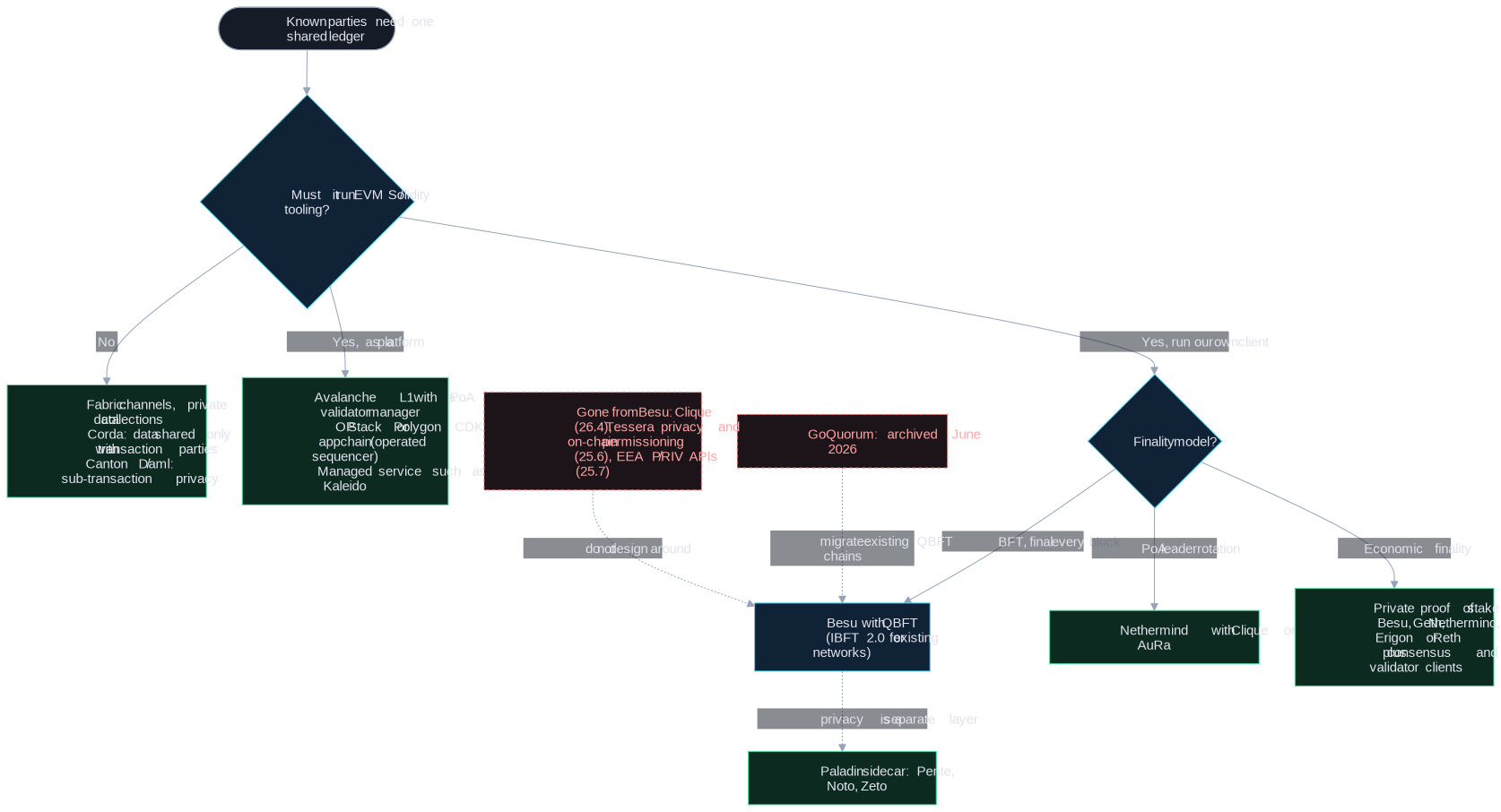
GoQuorum. Not for anything new. It still runs and still speaks QBFT, but archived means no security fixes and no new EVM forks.
Geth. The most widely used mainnet execution client, and for years a Clique network on Geth was the standard private chain. That path is closed. Since Geth 1.14.0 (spring 2024), Geth cannot seal Clique blocks or run any pre-merge network; a consensus client must drive it through the Engine API. A private Geth chain today means a private proof-of-stake network: Geth plus a beacon client plus validator clients, with a deposit contract and the staking machinery. That works, and it is how the Geth team now suggests running test networks, but proof of stake gives economic finality after two epochs (about 12.8 minutes with 32 slots of 12 seconds) instead of BFT finality every block. For a consortium of known parties that is a lot of machinery for a weaker guarantee.
Erigon and Reth. Erigon went the same way: v3.5.0 removed its Clique engine, including configuration and database support. Reth, Paradigm’s Rust client, is a mainnet execution client and an SDK for custom nodes. It has no built-in BFT engine, so a Reth-based permissioned chain is something you build, not something you configure.
Nethermind. The exception. The .NET client still supports two proof-of-authority engines: Clique, and AuRa (Authority Round), the round-robin engine from the Parity client that still underlies Gnosis Chain’s history and networks such as Energy Web. AuRa private chains must be enabled explicitly in configuration. Nethermind has no QBFT or IBFT 2.0, and neither Clique nor AuRa gives single-block BFT finality: both are leader-rotation schemes in which forks are possible.
Platforms rather than clients. An Avalanche L1 (formerly a subnet) can run a permissioned validator set managed by a proof-of-authority validator manager contract, where only the owner adds or removes validators, with Avalanche consensus underneath and its EVM on top. Rollup stacks such as the OP Stack or Polygon CDK let you run a private appchain whose sequencer you control while settling or anchoring to a public chain. You trade a BFT validator set for one operated sequencer plus fraud or validity proofs, which changes the trust model completely: one operator orders transactions and the public chain arbitrates. Managed providers, Kaleido best known among them, sell this as a hosted service.
Outside the EVM. Hyperledger Fabric uses an execute, order, validate pipeline with channels, private data collections and identities from membership services. That gives privacy by partitioning rather than cryptography, at the cost of chaincode instead of Solidity and leaving EVM tooling behind. Corda, from R3, shares data only between the parties to a transaction and has no global broadcast ledger. Canton, built around the Daml language, offers sub-transaction privacy, where each party sees only the parts of a transaction it is entitled to, and has drawn substantial participation from banks and market-infrastructure firms. If privacy between participants is the core requirement, and Drex suggests it often is, these deserve a serious look before you commit to an EVM chain with privacy added later.
The five layers of a Besu node
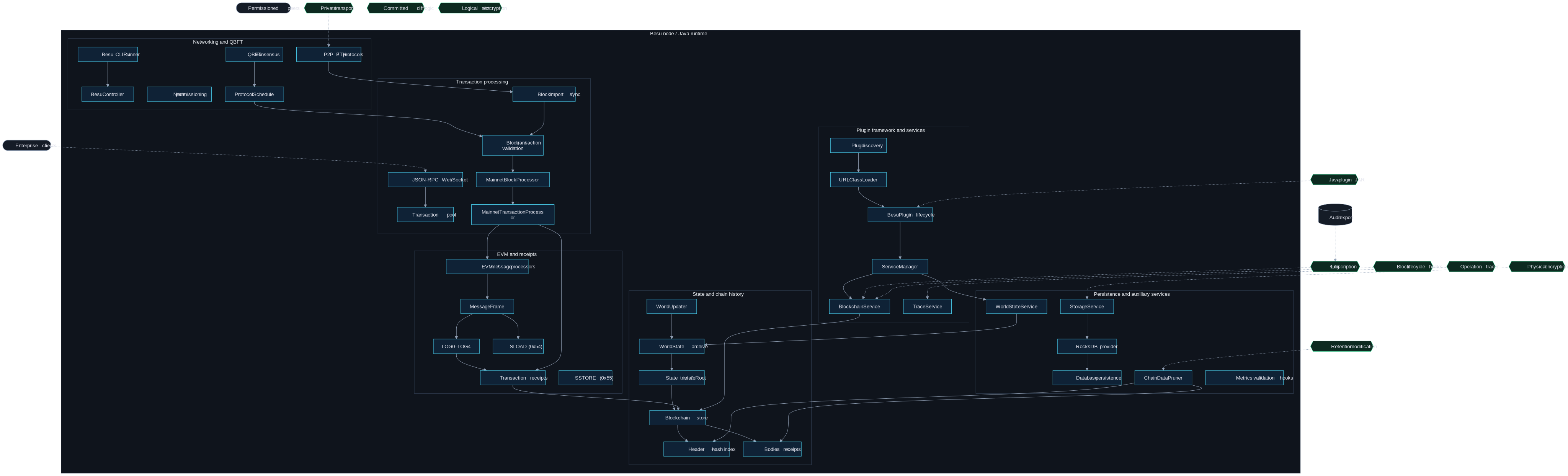
Think of one Besu node as a small transaction-processing system with five layers:
- Communication. JSON-RPC (HTTP and WebSocket) for applications, and Ethereum’s peer-to-peer protocol (RLPx and the ETH sub-protocol) for other nodes.
- Consensus and block management. QBFT, block import, synchronization.
- Execution. Transaction validation, the EVM, gas accounting, receipts.
- Logical world state. Accounts, code, balances, contract storage, the state trie and its root.
- Physical persistence. Usually RocksDB, holding the structures from which Besu reconstructs state and chain history.
A sixth mechanism cuts across them: the plugin framework. It does not replace the normal flow. It exposes selected services and hooks to Java code loaded into the Besu process.
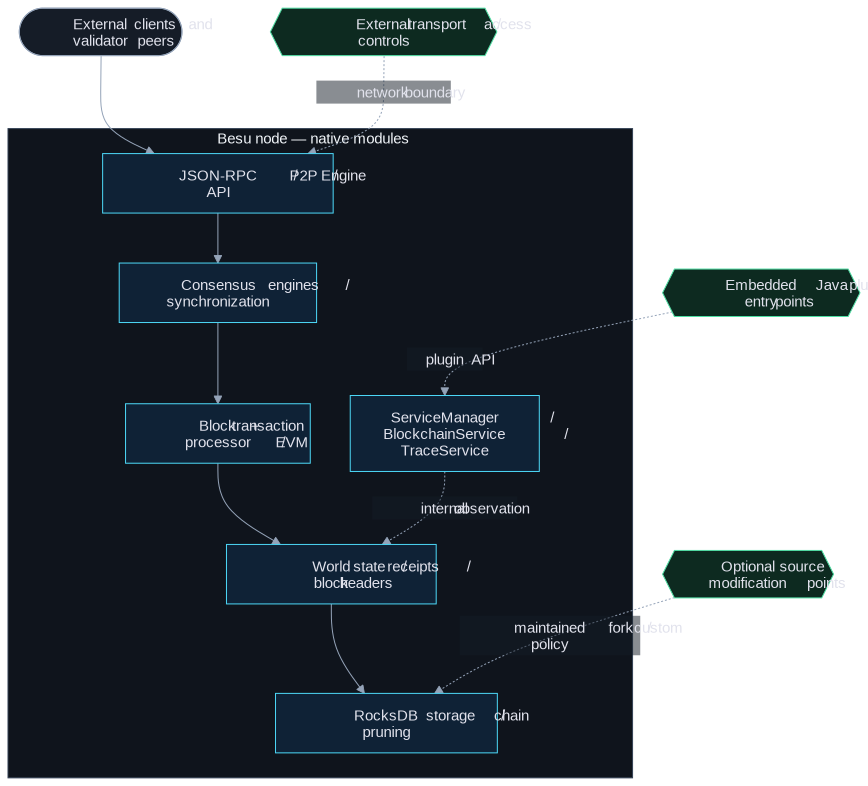
Separating the layers answers a common question. Does QBFT mean Besu no longer needs most of Ethereum? No. QBFT changes how a block is proposed, agreed and finalized. It does not remove Ethereum transaction semantics. An Ethereum-compatible contract still needs the EVM, gas rules, nonces, world state, receipts, state roots and persistence.
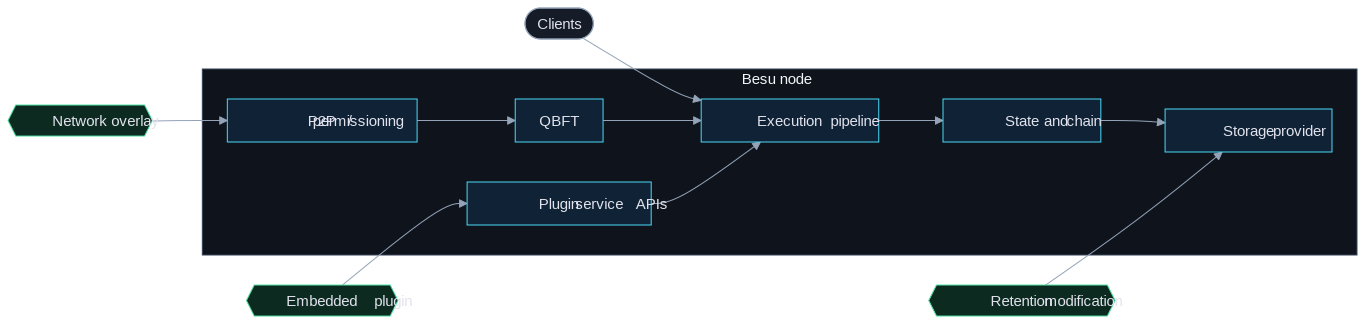
The interactive explorer below is built from the same source commit. It has a full Besu view and a corporate QBFT view, search, highlighted event, trace and encryption paths, pan and zoom, SVG export, and a source link for every native component. Expand it, or open it in its own tab.
Following a transaction to a final block
An application submits a signed transaction, ideally through a JSON-RPC endpoint with TLS, client certificates and method-level authorization. Besu validates it against the current rules and puts it in the transaction pool, the waiting room for transactions received but not yet in a block. The pool is useful even when every sender is a corporate system: it receives, validates, gossips and selects work for block production.
The protocol schedule picks the protocol specification for the current block height. That matters on a private chain too. “The EVM” is not one thing: gas costs, transaction types, the opcode set, and even a per-transaction gas cap (EIP-7825) come from whichever hard-fork rules are active at that block. In a Besu QBFT genesis these activations are milestone blocks, next to QBFT settings such as blockperiodseconds (a minimum, not a guarantee), emptyblockperiodseconds and epochlength. Every validator must use the same schedule or they can compute different results for the same transaction.
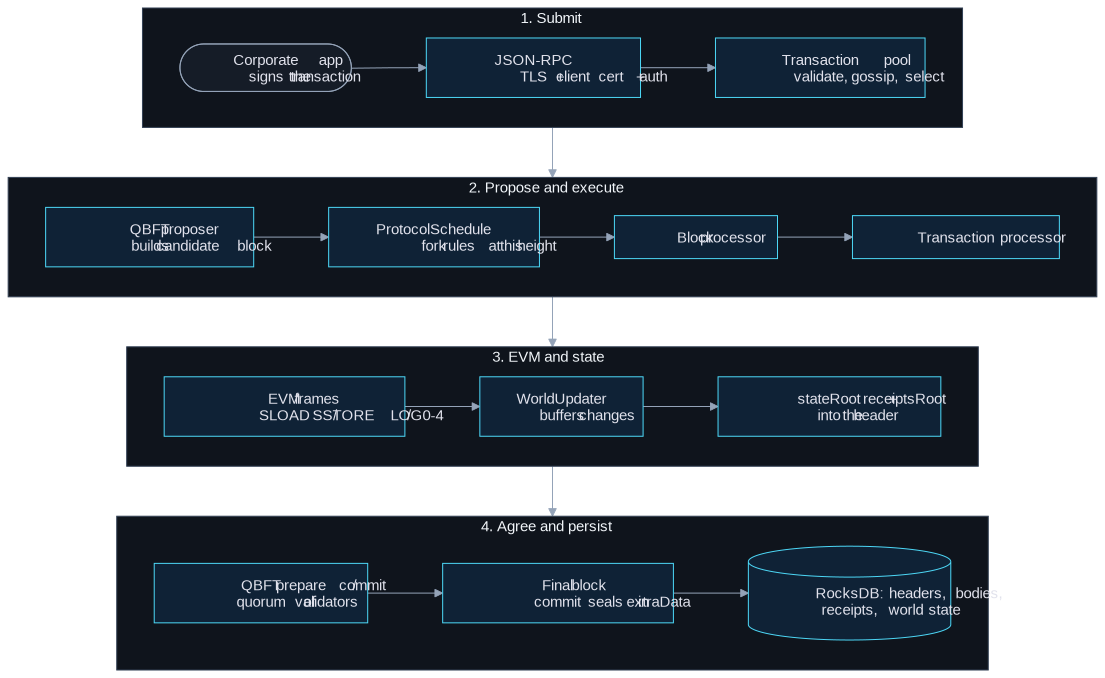
Then a validator proposes a block. QBFT is Byzantine fault tolerant: with n = 3f + 1 validators it tolerates f faulty or malicious ones. With four validators it tolerates one, and a quorum is three. The proposer cannot declare success by assembling a block. The others must accept the proposal and take part. Messages move through three phases (proposal, prepare, commit), with a round change if progress stalls and the next proposer takes over.
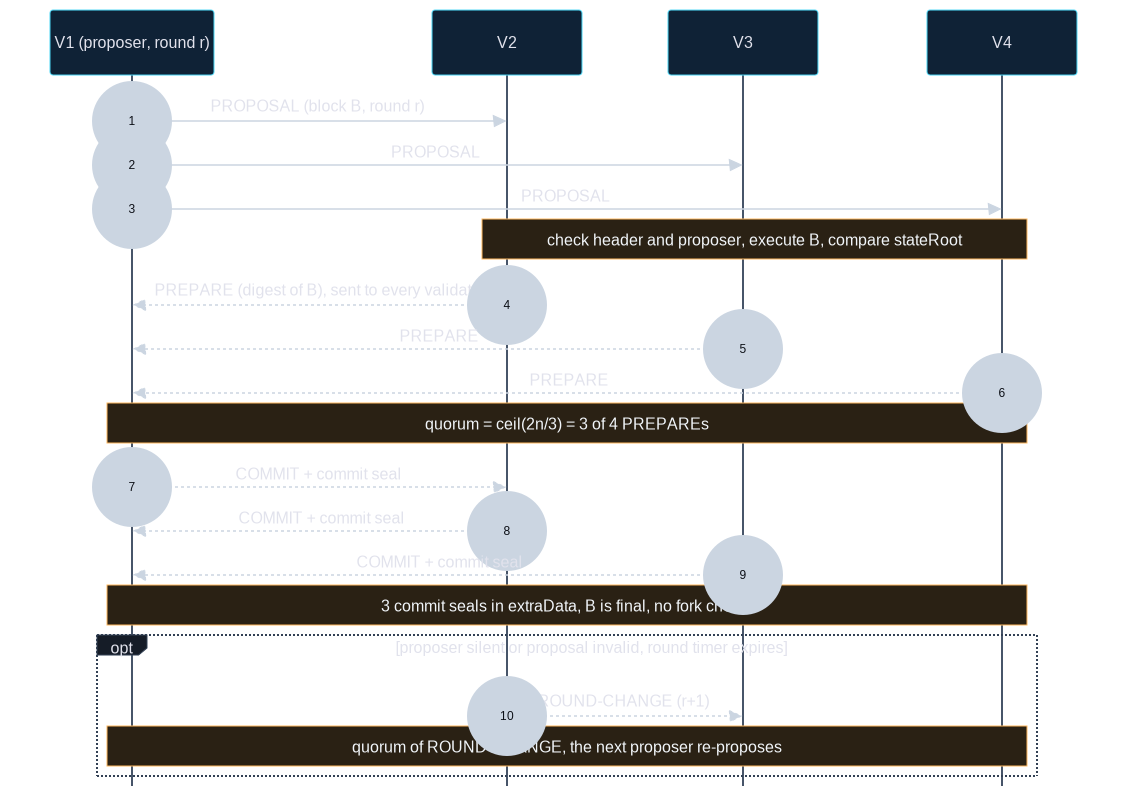
The validators are not racing for a winning hash and do not need Ethereum’s beacon chain. A known membership set, protocol messages and quorum evidence decide which block joins the chain, and once committed it is final. No probabilistic confirmation and no waiting for a checkpoint. But BFT is not immunity from operations. If too many validators are offline, or a partition leaves no group big enough for a quorum, the network halts rather than forks. If operators disagree on genesis, protocol settings, validator membership or software behavior, QBFT will not repair it. Consensus protects agreement under stated assumptions. It does not replace configuration management.
Once Besu has a block to execute or validate, MainnetBlockProcessor runs its transactions under the applicable protocol spec and MainnetTransactionProcessor sets up the EVM context. The EVM runs bytecode instruction by instruction with a stack, memory, gas counters and a MessageFrame per nested call. A call into another contract creates a new frame, but every effect still belongs to the enclosing transaction.
Contract storage, traces and event logs
A Solidity state variable is not a labeled Java object in RocksDB. The compiler lays values out in storage slots, and the EVM treats each slot as a 256-bit key mapped to a 256-bit value. SLOAD (opcode 0x54) reads a slot. SSTORE (0x55) attempts to update one. In Besu’s source both end up as calls on an account object, through a world-state updater that buffers changes until commit. SStoreOperation reads key and new value from the stack, computes gas from current and original values, calls MutableAccount.setStorageValue, and records the update in the frame.
Attempts matters. A later revert can cancel an SSTORE. A transaction can fail after several apparent writes. Gas rules, STATICCALL restrictions and account state can prevent a write. An audit system has to distinguish three things: an instruction was attempted, a value changed inside a temporary frame, and a value was committed as part of the accepted transaction and block. A trace is a history of what the EVM tried to do, not a final state diff.
Execution also produces logs, from LOG0 through LOG4 (the digit is the number of indexed topics). A Solidity event usually compiles to one of them: emitting address, zero to four 32-byte topics, and a data payload. By convention the first topic is the hash of the event signature, and the ABI tells you how to decode the rest. Logs do not live in contract storage. They are part of the transaction receipt, and if the execution reverts they do not survive. Contracts cannot query the historical log stream.
Executing the block yields transaction outcomes and a new world state. Besu computes commitments, including the state root and receipts root, that go into the header. The database stores headers, bodies, receipts, indexes and the world-state data for later execution. Consensus does not vote on the physical database byte for byte. It relies on the agreed logical state transition and its commitments. That is the key to the encryption section.
The plugin framework
A Besu plugin is ordinary Java loaded into the same JVM as Besu. A JAR contains a class implementing BesuPlugin, and Java’s ServiceLoader discovers it at startup through META-INF/services/org.hyperledger.besu.plugin.BesuPlugin. No microservice, no JSON-RPC polling.
- Discovery. JARs directly under the plugins directory (non-recursive). Default
besu.home/plugins, overridable with the JVM property-Dbesu.plugins.dir=/path;--pluginscan restrict which plugins load. - Lifecycle.
register(ServiceManager)runs early and should keep the reference.start()runs when runtime services are ready; subscribe or start workers here.stop()cancels subscriptions and releases resources. Optional hooks such asbeforeExternalServices()cover early registration and configuration reloads. - Services. The
ServiceManageris a limited set of doors, not unrestricted access:BlockchainService,TraceService,WorldStateService,StorageService, metrics, transaction-pool and transaction-selection services, permissioning, security modules and others.BesuEventsis deprecated in favor ofBlockchainServicesubscriptions. Some interfaces are@Unstable, and the plugin API is being split into smaller, separately versioned modules with binary-compatibility checks. - No sandbox. A plugin runs in the client’s process. It can block threads, exhaust memory, throw, or stall a validator. No network hop is convenient, and it raises the bar for the plugin author.
What the current plugin APIs can and cannot do:
| Goal | API / code path | Without changing Besu? | Limit |
|---|---|---|---|
| Capture all emitted event logs | BlockchainService.subscribeLogs(List.of(), List.of(), listener) |
Yes | Logs are not every internal operation. Handle reorg removed markers. |
| Blocks, receipts, transaction IDs | subscribeBlockAdded, subscribeBlockReorg, getReceiptsByBlockHash |
Yes | Notification timing is separate from finality; reconcile forks. |
Every SLOAD / SSTORE |
TraceService.traceBlock + BlockAwareOperationTracer (tracePreExecution / tracePostExecution) |
Yes, by replay | Not a callback in the live execution path. Handle halts, nested calls, reverts. |
| Final storage value at a block | WorldStateService.getWorldView(hash) |
Read-only, if state is available | Not a state-diff subscription. Pruned historical state may be gone. |
| Committed storage changes per transaction | Replay with state comparison | Needs custom tracer logic | No ready-made subscribeStorageChanged. |
| Custom RPC or validation policy | RpcEndpointService, TransactionValidatorService |
Yes, scoped | Validation rules change acceptance and can diverge between validators. |
| Replace the key-value database | StorageService.registerKeyValueStorage + KeyValueStorageFactory |
Yes, substantial work | Replaces the storage backend, not EVM storage opcodes. |
| Encrypt the database at rest | Custom KV provider or encrypted filesystem | Yes in principle | Below the logical state layer; roots unchanged. |
Encrypt values on every SSTORE / SLOAD |
None | Not via the plugin API | Changes EVM values, gas, proofs and consensus. |
Example one: capturing every event
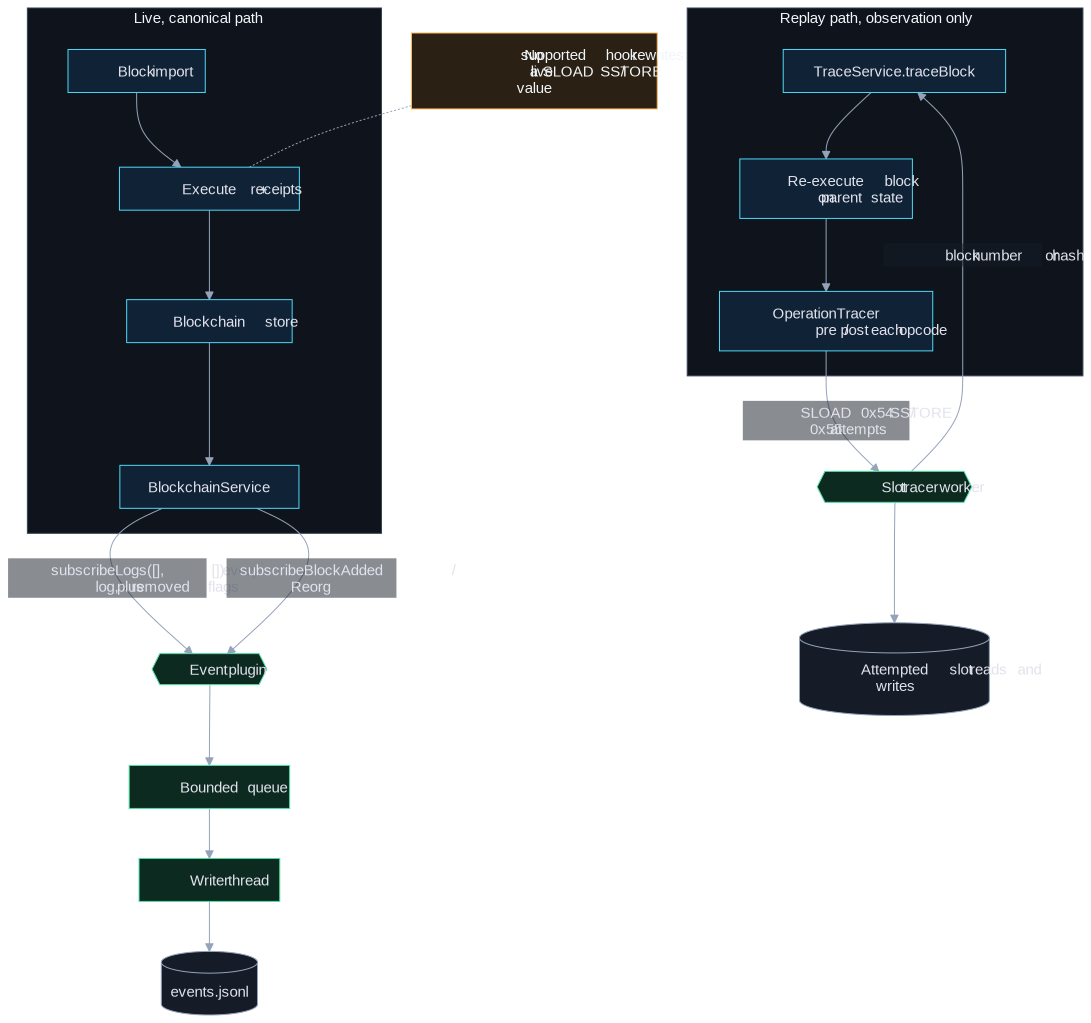
The plugin asks the ServiceManager for BlockchainService and subscribes to logs with an empty address list and an empty topic list. Empty filters match everything. Each callback carries a LogWithMetadata: emitting address, topics, data, block number and hash, transaction hash and index, log index, and whether a reorg removed it.
@Override
public void start() {
  BlockchainService chain = services.getService(BlockchainService.class)
      .orElseThrow(() -> new IllegalStateException("BlockchainService unavailable"));
  // ... open the output file, start the writer thread ...
  // Empty address and topic filters: every emitted log.
  subscription = chain.subscribeLogs(List.of(), List.of(), this::onLog);
}

private void onLog(LogWithMetadata log) {
  String record = toJson(log);          // copy now; don't keep the borrowed object
  if (!buffer.offer(record)) dropped.incrementAndGet();   // never block the callback
}
The callback turns each log into one JSON line on a bounded queue, and a separate writer thread appends to disk, so block processing never waits on slow I/O. An illustrative record (not captured from a running node):
{"blockNumber":12345,"blockHash":"0x…","transactionHash":"0x…","transactionIndex":0,"logIndex":0,"address":"0x…","topics":["0x…"],"data":"0x…","removed":false}
This separates consensus data from observability data. Other validators do not need the same plugin; they need compatible consensus and execution rules, not identical audit outputs. The caveats: callbacks can report removals during a reorg (rare under QBFT, but the API is shared with public-chain modes), and a subscription is not a backfill strategy. After downtime, reconcile against receipts the node still holds, or an archive if they have been pruned. A production version needs a durable outbox or WAL instead of a dropping queue, deduplication on (blockHash, transactionHash, logIndex, removed), startup backfill from a checkpoint, and protected, rotated output.
Example two: tracing every storage read and write
To see every SLOAD and SSTORE, including writes no event announces, a plugin calls TraceService.traceBlock(number or hash, tracer) from a worker thread. TraceServiceImpl reconstructs the parent state, runs the block’s system calls, replays the transactions with your OperationTracer, and calls the block hooks. tracePreExecution(MessageFrame) sees each opcode before it runs; tracePostExecution(MessageFrame, OperationResult) sees the outcome.
public void tracePreExecution(MessageFrame frame) {
  int op = frame.getCurrentOperation().getOpcode();
  if (op != 0x54 && op != 0x55) return;               // SLOAD, SSTORE only
  boolean v2 = frame.runsOnEvmV2();                     // two stack backends exist
  int needed = (op == 0x55) ? 2 : 1;
  if (v2 ? !frame.stackHasItemsV2(needed) : frame.stackSize() < needed) return;
  UInt256 slot = UInt256.fromBytes(v2 ? frame.stackItemV2(0) : frame.getStackItem(0));
  UInt256 value = (op == 0x55)
      ? UInt256.fromBytes(v2 ? frame.stackItemV2(1) : frame.getStackItem(1)) : null;
  sink.accept(new Access(op == 0x54 ? "SLOAD" : "SSTORE",
      frame.getRecipientAddress(), frame.getPC(), frame.getDepth(), slot, value));
}
Replay is the key word. This is not a hook in the live, consensus-critical execution; it re-executes an already accepted block purely to observe it. Recent Besu has two stack implementations, the original operand stack and a second-generation layout used by a reworked execution path, so a tracer must not assume one way of reading the stack works in every frame. A useful record says: at block 500,000, in transaction T, at call depth 2, contract A attempted an SSTORE on slot K with value V. A second stage correlates that with success, reverts and final state.
Replay needs work and the historical state at the parent block. Tracing every opcode on every validator eats CPU, disk I/O and storage bandwidth that should serve block processing; use dedicated observer nodes or a throttled worker. And “without modifying Besu” has limits: there is no supported hook that hands you every live storage read and write and lets you replace the value before the EVM sees it.
Both classes, the Gradle build and the ServiceLoader registration are in the example plugin archive. They were syntax-checked against interface stubs, not built or run against a real Besu 26.11 distribution, so check API compatibility against the exact release you deploy.
Encryption at rest, and what it cannot hide
Suppose a contract stores 42 in a slot. You want an administrator looking at the disk to see ciphertext while the EVM keeps seeing 42. That is encryption at rest, and it can be solved below the logical storage interface, with a storage provider registered through StorageService or with an encrypted volume. That extension point affects persistence. It is not interception of SLOAD or SSTORE.
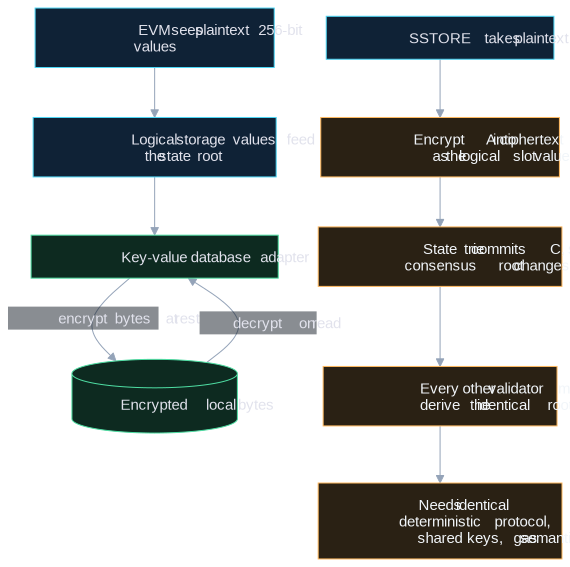
If encryption happens below the logical world-state representation, Besu sees the original values when computing transitions and hashes. Different nodes can even use different keys for their local databases: raw bytes differ, state roots match. That is compatible with consensus, provided the storage implementation preserves Besu’s exact logical behavior. A correct replacement key-value store is not a one-line encrypt function. Besu keeps many categories of data in separate segments, some needed at startup, recovery, sync and rollback, and the adapter must handle reads, writes, atomic batches, segments, snapshots, iteration and range queries, deletion, restarts and crash recovery. If the requirement is only that a stolen disk reveals no plaintext, whole-volume encryption is far simpler.
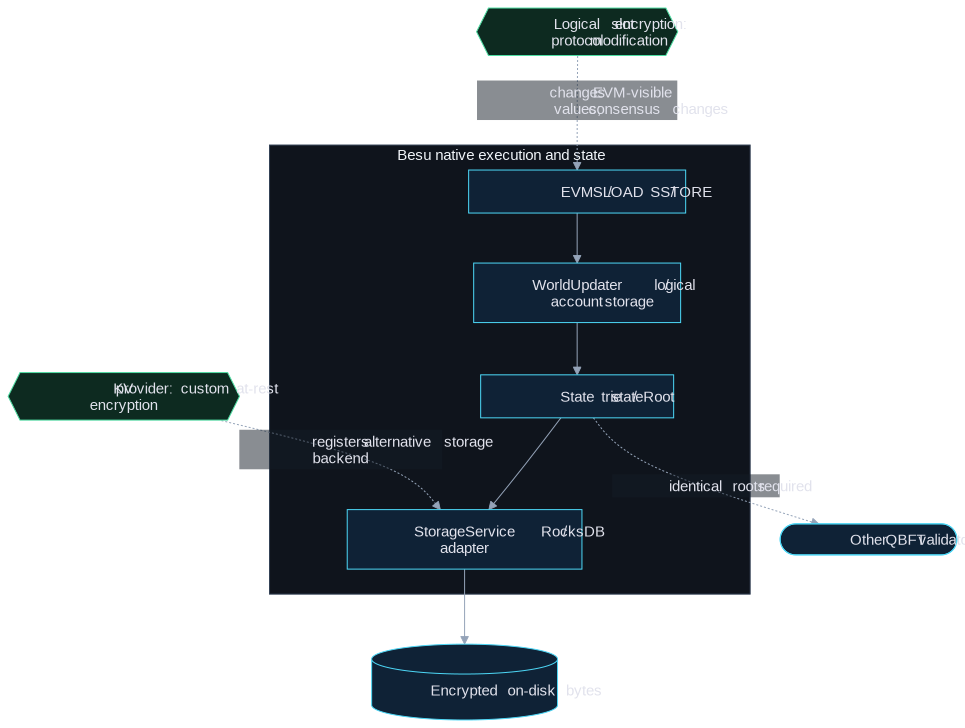
Now the ambitious version: the chain itself holds encrypted storage values. An SSTORE silently becomes ciphertext before it enters state, and the next SLOAD silently decrypts. The state root commits to the logical data, so if two validators store different ciphertexts their roots differ and the chain cannot agree. Random-nonce encryption guarantees that. Deterministic encryption removes the divergence but leaks equality between values; ciphertext may not fit in 256 bits; gas accounting depends on zero, current and original values; and eth_getStorageAt, proofs, tracing and state sync all change. And there is still no plugin interception point.
You could define a custom execution protocol where every validator encrypts and decrypts identically. Then you have changed the rules of the chain: every validating node must agree on them and on key management, and it no longer interoperates with unmodified Besu. There is a more basic point too. If every validator holds the keys to decrypt during execution, every validator can read the plaintext. Database encryption does not create confidentiality from validator operators. If some participants must not see some data, you need a privacy design: application-level encryption, off-chain data with on-chain commitments, selectively shared state, trusted execution, ZK proofs, or a privacy protocol. In today’s Besu ecosystem that last option means Paladin, because Tessera is gone. Event data is public chain data too: a plugin can write logs to disk, but cannot make them secret from participants who already have the receipts.
Simplifying Besu for a private network
“Simplify” can mean configuring the standard distribution so that unneeded features are inactive, or removing source modules and shipping a smaller binary. The first is practical. The second is a product you maintain.
| Component | Needed by a private QBFT validator? | Why |
|---|---|---|
QBFT consensus (consensus:qbft, consensus:qbft-core, shared BFT code) |
Yes | Proposals, validator messaging, round state machine, commit seals, recovery. |
| EVM, transaction execution, world state, trie, RocksDB, block and receipt storage | Yes | QBFT replaces consensus, not Ethereum state-transition validity. |
| P2P (RLPx), ETH protocol, synchronization | Yes | Validators and peers must talk and recover. Discovery can be disabled with static peers. |
| Transaction pool | Typically yes | Propagation, validation and block building, even when apps submit via RPC. |
| Merge / PoS integration and Engine API | No, for standalone QBFT | No beacon client; do not expose the Engine API. That does not prove the modules are safe to delete. |
| Other consensus code (IBFT 2.0 for existing networks; legacy IBFT 1.0 and Clique code kept for migration and historical sync) | Not on the active QBFT path | Keep compiled unless you ship your own tested distribution. Clique cannot seal blocks in current Besu. |
| Public bootnodes, open discovery | No | Static peers, an explicit node allowlist and private connectivity. |
| JSON-RPC, WebSocket, GraphQL, metrics, admin APIs | Per endpoint | Expose only what is used, but keep monitoring and an authorized management path. |
| PoW, public fork machinery, blob and Engine-related code | Mostly inactive | Shared schedules and helpers are used by common code; only a dependency graph proves removability. |
Plugin infrastructure (BesuPlugin, ServiceManager) |
Optional; useful here | Needed for in-process event capture and tracing. |
So the first optimization is not a fork that deletes packages. It is a well-configured, well-defended standard node: turn off unneeded RPC API groups, bind sensitive endpoints to private interfaces, use known peer identities, disable discovery you do not need, and keep monitoring reachable only by authorized systems. If a reduced build is still worth it, map and test its real dependency graph, and plan to carry that fork through every security fix and protocol upgrade. The November 18 patch release that changes a JVM flag to sidestep a vulnerability shows how often that happens.
The network boundary
Does Besu support TLS between all nodes? Besu peers already use RLPx, Ethereum’s standard transport: an ECIES handshake based on the nodes’ secp256k1 keys derives fresh session keys, and sessions are encrypted and integrity-protected. No Besu node receives peer messages over a plaintext socket. But this is not corporate certificate-based TLS. A node key is a bare elliptic-curve key pair, not an X.509 certificate from your enterprise CA. Besu’s experimental P2P TLS feature was removed in 24.12.0, so do not design around it. The right design depends on what the security requirement actually says.
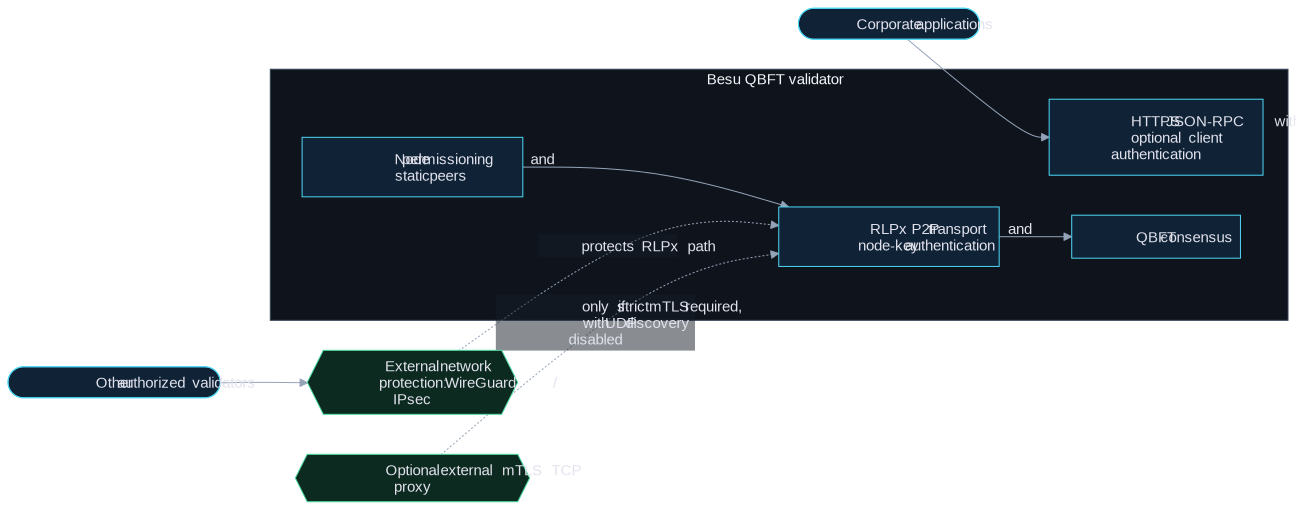
- Encrypted private connectivity everywhere. An IPsec or WireGuard overlay between machines is the coverage-first choice. Besu keeps RLPx inside the tunnel. Restrict inbound traffic to the overlay interfaces, rotate tunnel keys, and make sure no P2P or management traffic can bypass it. Both TCP and UDP matter if discovery is on. An overlay is not TLS, so do not describe it as meeting a literal X.509 mutual-TLS requirement.
- Literal mutual TLS with organization certificates. Disable UDP discovery, configure fixed enodes with
--static-nodes-file, and put a transparent L4 TLS proxy or sidecar with mutual certificate authentication at both ends of every peer connection, carrying the RLPx TCP stream inside TLS. Inbound and outbound routing and the advertisedenode://addresses must line up. That is real network engineering, not a flag. - Application JSON-RPC. Besu supports TLS and client-certificate verification natively. Decide who may call sensitive methods with credential-file or JWT authentication; transport encryption alone is not authorization.
A validator with static peers, a local node allowlist and mutual-TLS RPC looks like this:
besu \
  --genesis-file=/etc/besu/genesis-qbft.json \
  --data-path=/var/lib/besu \
  --p2p-interface=10.50.0.11 \
  --p2p-host=10.50.0.11 \
  --p2p-port=30303 \
  --discovery-enabled=false \
  --static-nodes-file=/etc/besu/static-nodes.json \
  --permissions-nodes-config-file-enabled=true \
  --permissions-nodes-config-file=/etc/besu/permissions_config.toml \
  --rpc-http-enabled=true \
  --rpc-http-host=10.50.0.11 \
  --rpc-http-tls-enabled=true \
  --rpc-http-tls-keystore-file=/etc/besu/rpc-server.p12 \
  --rpc-http-tls-keystore-password-file=/etc/besu/rpc-server.pass \
  --rpc-http-tls-client-auth-enabled=true \
  --rpc-http-tls-truststore-file=/etc/besu/client-ca-truststore.p12 \
  --rpc-http-tls-truststore-password-file=/etc/besu/client-ca-truststore.pass
--p2p-interface is where Besu listens; --p2p-host is what it advertises. static-nodes.json lists enode://<node-public-key>@<overlay-ip>:<port> URIs, and permissions_config.toml holds nodes-allowlist=[...]. In a sidecar design these addresses must follow the proxy topology. This sample secures HTTP RPC, not RLPx.
Use at least two complementary controls: encrypted transport (RLPx inside an overlay, or a properly engineered TLS proxy) and peer authorization (static peers plus a node allowlist). In current Besu these allowlists are local files on each node, optionally extended by a permissioning plugin; the on-chain contract option is gone. A certificate proves an organization’s identity to a TLS proxy. The allowlist proves an Ethereum peer identity to Besu. Keeping those two identity maps consistent is an operational control you must own.
Deleting history after 124 days
The hardest requirement: delete history older than 124 days. What makes a blockchain a blockchain is not that nothing is ever deleted. It is a sequence of cryptographically linked blocks plus agreement about state transitions and their commitments. A header holds its parent’s hash, the transactions root, receipts root and state root, and in QBFT the validator list and committed seals in extraData. The header hash is the block’s identity.
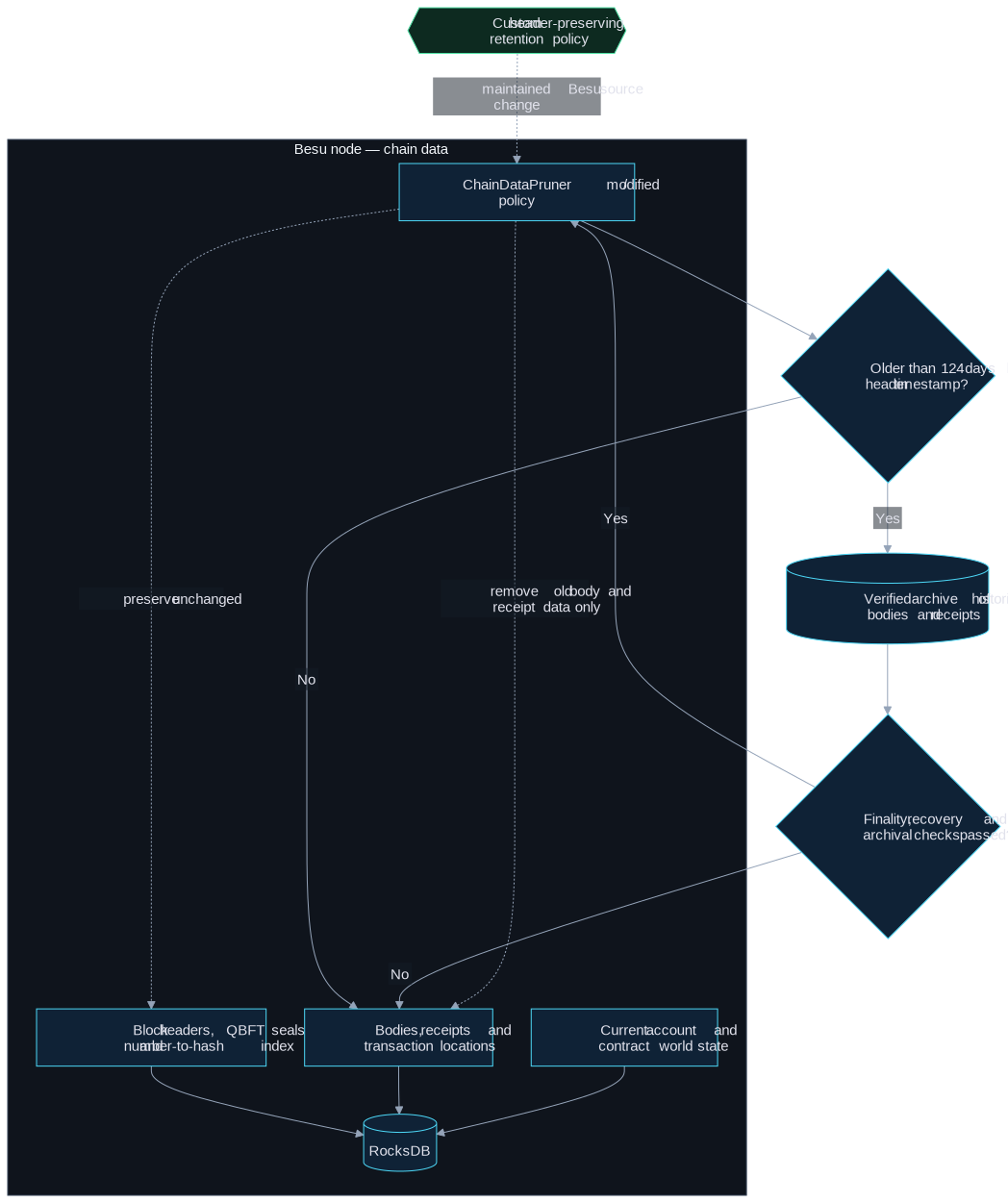
So a block’s body and receipts are not its header. If the body goes and the header stays, the header chain stays connected: you keep the claim that the block existed, its position, parent and commitments. You lose the ability to inspect or replay the deleted transactions on that node. That suggests a policy: keep all headers and the canonical number-to-hash mapping forever, keep the current world state, keep bodies and receipts for a rolling 124 days, and export older detail to a separately governed archive if audit or recovery needs it.
What Besu ships does not do exactly that. Chain-data pruning lives behind experimental --Xchain-pruning-* options:
ALLsounds right, butChainDataPruner.removeChainData()callsremoveBlockHeader,removeBlockBody,removeTransactionReceiptsand the transaction-location cleanup, and its loop callsremoveBlockHash(blockNum). It removes old headers and the number-to-hash index too.BALprunes block access lists (the per-block records of touched accounts and storage used for parallel execution), not bodies.- The history-expiry path for public Ethereum removes pre-Merge bodies and receipts. It does not apply to a QBFT chain with a calendar rule.
BlockchainServiceoffers reads and subscriptions, not a supported header-preserving deletion API. A callback plugin cannot do this without internal storage details. Never delete RocksDB records under a running node.
Two paths:
Option A, configuration only, headers archived outside Besu. Subscribe to every new block, export and verify its complete header (canonical height and hash, QBFT evidence) to an immutable corporate archive, then run built-in ALL pruning. At a steady 5-second cadence:
--Xchain-pruning-enabled=ALL \
--Xchain-pruning-blocks-retained=2142720 \
--Xchain-pruning-bals-retained=2142720
This removes old headers inside Besu, and the window is approximate. It works only if the external archive satisfies the audit requirement and you accept reduced on-node history and replay.
Option B, keep every header in Besu, which needs a code change. Modify the ChainDataPruner retention strategy and its BlockchainStorage.Updater calls. A design sketch, not a compilable patch:
long cutoff = clock.instant().minus(Duration.ofDays(124)).getEpochSecond();
for (long h = nextUnprunedHeight; h < safePruningHeight; h++) {
  BlockHeader header = requireHeader(h);          // keep header + hash index
  if (header.getTimestamp() >= cutoff) break;
  if (!isSafeToPrune(h)) break;                    // finality, sync, archive checks
  for (Hash blockHash : hashesAtHeightIncludingForks(h)) {
    updater.removeBlockBody(blockHash);
    updater.removeTransactionReceipts(blockHash);
    removeTransactionLocations(updater, blockHash);
    // do NOT call removeBlockHeader(blockHash)
  }
  // do NOT call removeBlockHash(h)
  persistPruningProgressTransactionally(h);
}
It must not touch current world state, must handle non-canonical fork blocks, sync requirements and crash-safe progress, and should be transactional where the storage layer allows. Why keep stressing current state? Because history and state are different dimensions. A balance written six months ago may still be today’s balance; the current state is the accumulated result of every past transition, and the next block needs it. Deleting an old body does not reverse its effects. Equally, a node can keep current values but lose the ability to reconstruct them at old heights, which affects historical tracing and RPC queries against old blocks. A header-preserving chain is not an archive node.
124 days is a time, not a block count, and Besu’s options count blocks. Approximate sizes at steady intervals:
| QBFT block interval | Blocks in 124 days |
|---|---|
| 2 s | 5,356,800 |
| 5 s | 2,142,720 |
| 10 s | 1,071,360 |
| 12 s | 892,800 |
| 15 s | 714,240 |
| 30 s | 357,120 |
QBFT blocks do not arrive at a fixed interval. blockperiodseconds is a minimum, production can pause, round changes add delay, and a longer emptyblockperiodseconds means fewer blocks in idle stretches. If regulation says “older than 124 days”, use an explicit time cutoff, a trustworthy clock policy and accepted header timestamps, plus a safety margin. Multiplying an assumed interval by a number of days is not compliance.
There is also a built-in floor inherited from Ethereum’s history expiry: ChainPrunerConfiguration.HISTORY_PRUNE_EPOCHS = 14299, times 32, is 457,568 blocks. On a 5-second chain that is about 26 days, so it does not block a 124-day policy. On a 30-second chain, 124 days is below the floor, and the hidden --Xchain-pruning-retained-minimum override applies, with an explicit caution in the source. Change it only deliberately, considering epoch length, lagging validators, backup recovery and new-node initialization.
A validator offline for six months cannot rebuild deleted bodies by asking peers for them by hash if every peer discarded them. A hash commits to data but cannot reproduce it. A brand-new node cannot replay from genesis if nobody kept the bodies. You need a state snapshot, an agreed checkpoint and sync strategy, or an archive. Snap sync, which downloads recent state instead of replaying history, works for BFT networks since 25.7.0. It helps, and it still has to be tested.
A practical layout: validators keep current state, all headers and the recent window of bodies and receipts; separately protected archive systems keep the older detail. If policy demands real deletion rather than cold storage, the organization must accept losing replay, some historical audit and some disaster recovery, and design other evidence. Deleting a body no longer needed for live processing should not change the next state transition or block hash, which is why careful history pruning can coexist with consensus. But “conceptually below consensus” does not prove an implementation safe. Before production: start several validators, run stateful contracts with events, nested calls and reverts, cross QBFT epoch boundaries, let pruning trigger, restart nodes, add and remove peers, bring an old validator back, initialize a new one, compare state roots and head hashes, and request deleted bodies and receipts on purpose. Failures should be predictable and honest, not silent corruption.
Can one private chain mix different EVM clients?
Ethereum mainnet deliberately runs several clients for resilience. Can a permissioned chain do the same? In principle, yes, if every node agrees on four things:
- Genesis, byte for byte. The genesis hash is the chain’s identity.
- The fork schedule: the exact block or timestamp at which each EVM upgrade activates.
- The consensus engine, including how validator sets are encoded and changed.
- The header format. A QBFT header carries the validator list, votes, round number and committed seals in
extraData, and every client must encode and verify it identically.
In practice the consensus engine is where it breaks.
| Engine | Maintained clients in late 2026 | Mixed-client chain? |
|---|---|---|
| QBFT | Besu (GoQuorum archived June 2026) | Only Besu + GoQuorum, and only as a migration step |
| IBFT 2.0 | Besu, for existing networks | No |
| Clique | Nethermind (removed from Geth 1.14, Erigon 3.5, Besu 26.4) | No longer realistic |
| AuRa | Nethermind | No |
| Proof of stake via the Engine API | Besu, Geth, Nethermind, Erigon, Reth, plus several consensus clients | Yes: real diversity, with staking and economic finality |
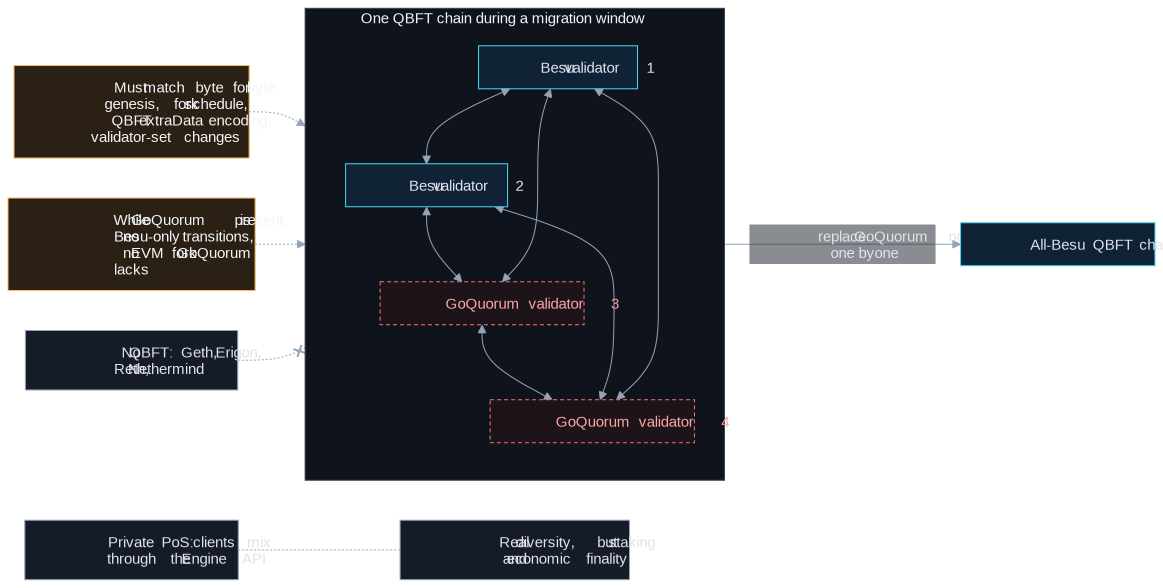
QBFT is implemented in Besu and GoQuorum and essentially nowhere else that matters, so a BFT consortium chain today has one maintained client. Besu and GoQuorum interoperate on QBFT, with limits. Migration guidance warns that Besu’s transitions for changing the validator-management method or adding validators without votes are Besu-specific, so you cannot rely on them while GoQuorum nodes are present. And because GoQuorum is frozen, the chain can never activate an EVM fork GoQuorum does not implement. A mixed Besu and GoQuorum network is a migration state, not a destination.
Permissioning is the second trap. Besu’s local permissioning is enforced per node, on what that node accepts and propagates. It does not stop a block produced by another node from containing a transaction your node would have refused. In a mixed network each client implements allowlists differently, or not at all, so the effective rule is the weakest node’s rule. The control that actually binds is the validator set: whoever produces blocks decides what gets in.
Client diversity protects against one implementation’s consensus bug forking or halting the network, which is why mainnet values it. In a small BFT consortium, though, two implementations that disagree on one edge case can split the validator set, and with four or seven validators losing a third halts the chain. You double upgrade testing, monitoring and incident playbooks. For most consortia the pragmatic answer is one well-maintained client, Besu on QBFT, with diversity elsewhere: different operators, cloud providers, regions, and independent key custody per validator. If you truly need multi-client resilience, the honest path today is private proof of stake, with its heavier machinery and slower finality.
Putting it together
A corporate application signs a transaction and submits it over mutually authenticated RPC. Networking and the transaction pool deliver it to a QBFT validator. The validators agree on a block. Besu executes it with the EVM under a common protocol schedule; SLOAD and SSTORE work on logical storage through a world-state updater; execution produces receipts and logs; the state root and other commitments bind the result to the header; the data persists locally, possibly on encrypted storage. An embedded plugin hands logs to a local durable pipeline, and a tracing worker replays selected blocks to observe storage access. Neither changes contracts or consensus. Peers use RLPx plus local allowlists, possibly inside an overlay, while RPC uses its own mutual TLS. Privacy between participants, if needed, is a separate layer such as Paladin, not a database setting. A carefully engineered pruning policy removes old detail and keeps the header chain and current state.
Keep four boundaries separate:
- Consensus: what all validators must agree on.
- Execution: contract semantics and the state root.
- Observability: what a plugin can read without influencing either.
- Persistence: which bytes are stored or discarded locally.
Capturing an event is observation. Replaying a block with a tracer is observation too, just expensive. Encrypting physical bytes can be transparent; transforming logical SSTORE values is a protocol change. Pruning old bodies can be safe under a defined policy; deleting current state is not. Removing Besu modules is a maintenance project, not a flag. And RLPx encryption is real encryption, but it is not certificate-based mutual TLS.
For the four-company network, the most maintainable start is deliberately conservative: a supported Besu release in QBFT mode, restricted peers and APIs, secured transport, embedded plugins for logs and selective tracing, encryption below the logical state boundary, and retention as an explicit architecture decision with a recovery plan. Modify Besu only where the supported extension points genuinely stop short, such as keeping every header while deleting bodies and receipts by age. Besu is at once a consensus participant, an Ethereum execution engine, a world-state manager, a database client and an extensible Java host. Knowing which of those roles you are touching is the difference between a safe enterprise customization and an accidental change to the rules of the chain.
Sources
Besu status, governance and releases
- Besu releases (26.11.1 and the CVE-2026-114938 workaround)
- Besu 26.4.0: repository moved to besu-eth, Clique removed
- LFDT 2026 mid-year Besu report: maintainers, JDK 25 since 26.6.0
- LFDT 2025 Q4 Besu report: IBFT 2.0 to QBFT migration, Clique sunset
- Besu governance
- Besu 25.6.0: on-chain permissioning and Tessera privacy removed · PR #8369
- Besu 25.7.0: EEA and PRIV RPC removed; snap sync for BFT networks
- Besu 24.12.0: P2P TLS removed; BesuContext renamed ServiceManager
- Besu 25.3.0: IBFT 1.0 to QBFT migration
Besu documentation
- Consensus protocols · Proof of authority · QBFT configuration
- Permissioning · Local permissioning · Permissioning plugin service
- Privacy with Paladin · Paladin architecture
Source code at commit 18bd7e6
- BesuPlugin · BesuPluginContextImpl · BesuPluginServiceRegistrar
- BlockchainService · LogWithMetadata · TraceService · TraceServiceImpl · OperationTracer
- SStoreOperation · SLoadOperation · KeyValueStorageFactory · RocksDBPlugin
- ChainDataPruner · ChainPruningOptions · ChainPrunerConfiguration
- ECIESHandshaker · JsonRpcHttpOptions · PermissionsOptions · P2PDiscoveryOptions
GoQuorum and other clients
- GoQuorum repository (archived) · “End support for GoQuorum” commit, June 5, 2026 · Besu issue #5984: Besu and GoQuorum on QBFT · GoQuorum QBFT docs · GoQuorum-to-Besu migration notes (third party)
- Geth v1.14.0 · Geth private networks with Kurtosis · Erigon v3.5.0 · Erigon PR #20532 · Nethermind AuRa · Nethermind 2.2.0
Platforms and deployments
- EBSI node operators · Paladin becomes an LFDT project · Kaleido permissioned chains
- Exame: Banco Central shuts down the Drex platform (November 2025)
- Avalanche PoA validator manager · Validator manager contract · OP Stack vs enterprise alternatives · Canton Summit 2026 takeaways · Hyperledger Fabric security model